SLOs and Error Budgets for SaaS Teams
Reliability targets are only useful if they change decisions. SLOs and error budgets help SaaS teams decide when to keep shipping and when to slow down before trust erodes.
Jason Overmier
Innovative Prospects Team
Most teams say they care about reliability. Far fewer can explain what level of reliability they are actually targeting or when feature work should pause because the system is getting too fragile.
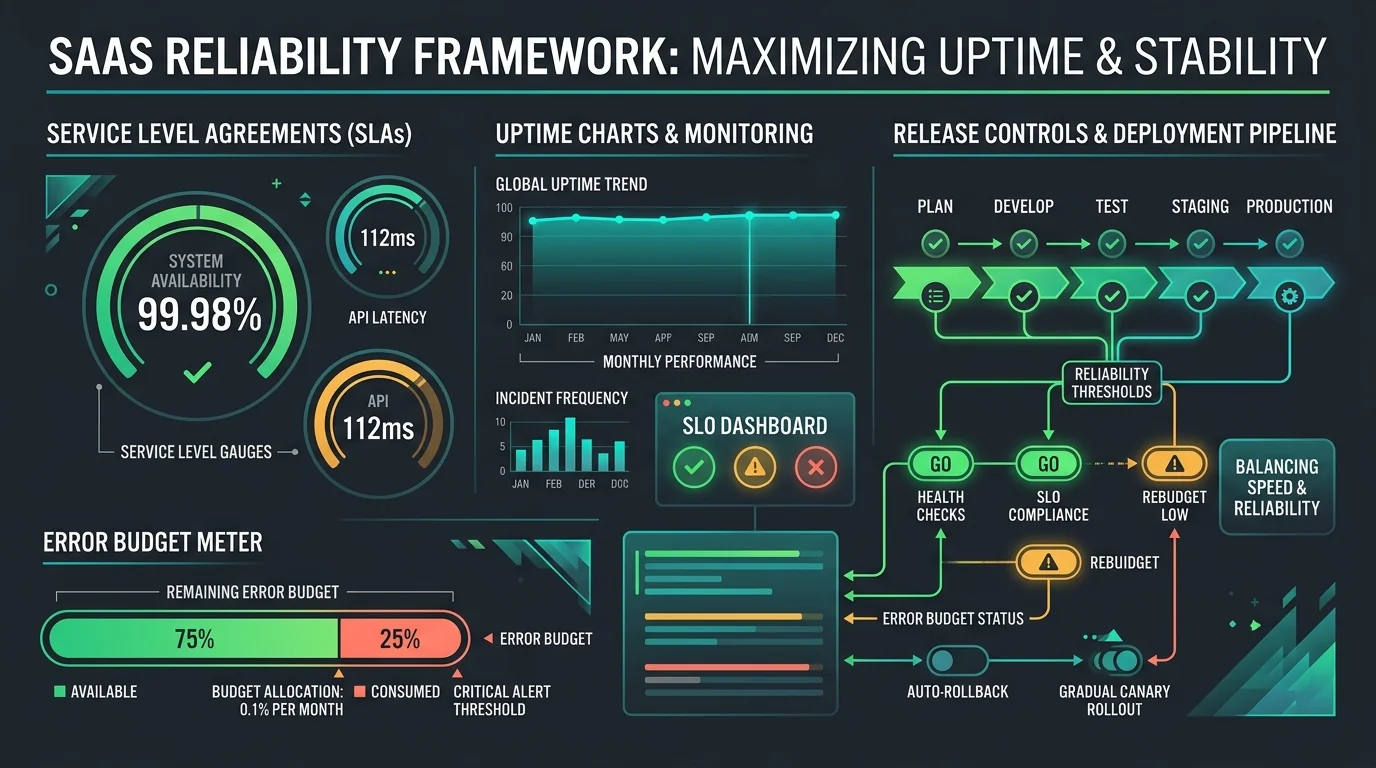
That is where service level indicators, service level objectives, and error budgets become useful. They turn reliability from a vague aspiration into an operating rule.
Quick Definitions
| Term | Meaning |
|---|---|
| SLI | The metric you measure, like request success rate or latency |
| SLO | The target you aim to meet, like 99.9% successful requests |
| Error budget | The amount of unreliability you can “spend” before slowing risky change |
Why SaaS Teams Need This
Without SLOs, teams usually make one of two mistakes:
- they overspend on reliability that users do not actually value
- they keep shipping through reliability degradation until customers notice first
SLOs help teams choose a middle path.
Picking the Right SLI
Good SLIs are tied to user experience:
- successful request rate
- API latency for critical endpoints
- job completion success for background workflows
- checkout completion for commerce products
- login success for core SaaS apps
Bad SLIs are metrics that are easy to measure but weakly tied to what users feel.
Choosing an SLO
| Reliability target | When it fits |
|---|---|
| 99.0% | Internal tools or lower-criticality workflows |
| 99.5% | Many business apps with workarounds |
| 99.9% | Revenue-critical or customer-facing core paths |
| 99.95%+ | High-stakes systems where downtime is very expensive |
The right target depends on business impact, not ambition alone.
What an Error Budget Changes
If your service has a 99.9% monthly SLO, you are allowed a small amount of failure before the team should become more conservative.
That means:
- if the budget is healthy, you can ship changes confidently
- if the budget is nearly exhausted, risky releases should slow down
- if the budget is blown, reliability work should take priority
That is what makes error budgets operationally useful.
Common Pitfalls
| Pitfall | Why It Happens | Fix |
|---|---|---|
| Teams choose vanity targets | Bigger numbers feel more impressive | Tie targets to user and business impact |
| SLIs are too broad | Averages hide painful edge cases | Track critical paths separately |
| Error budgets exist only in slides | No one uses them in release decisions | Define what happens when they are consumed |
| Reliability targets ignore support reality | Metrics and ops are separated | Review SLOs with engineering and support together |
The Better Outcome
SLOs should not produce more dashboards no one reads. They should produce better release decisions, clearer reliability priorities, and fewer arguments based entirely on gut feel.
If your team wants a more disciplined way to balance shipping speed against reliability risk, contact us. We help SaaS teams define SLOs, error budgets, and the operational rules that make them meaningful.