8-Week MVP Sprint: How We Ship Fast Without Breaking Things
Our AI-accelerated MVP process ships production-ready products in 8 weeks. Here's the week-by-week breakdown, quality gates, and what you actually get.
Jason Overmier
Innovative Prospects Team
The question we hear most often: “How long will my MVP take?”
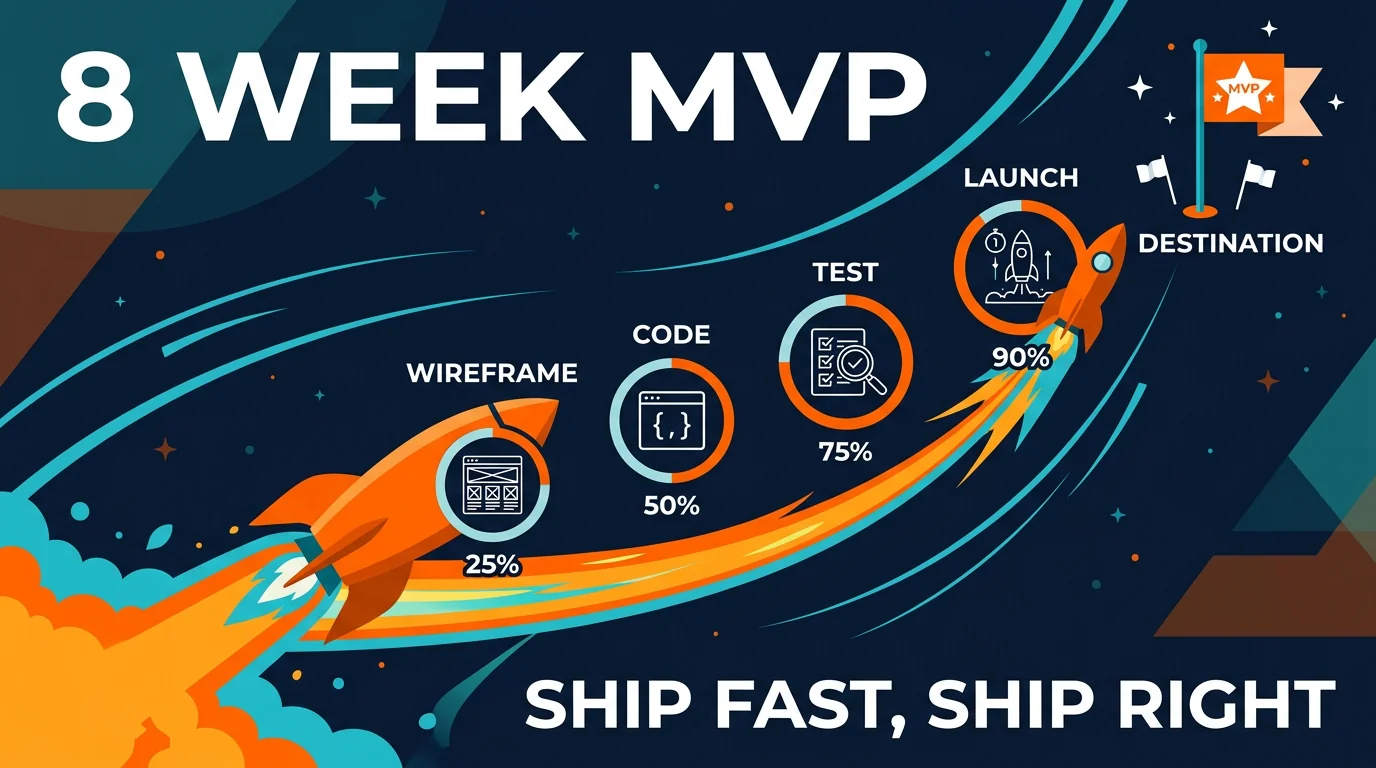
Our answer: 8 weeks. Not because it’s a nice round number, but because it’s enough time to build something real while short enough to maintain urgency and conserve runway.
This isn’t a rushed job that falls apart in production. It’s an AI-accelerated process that applies senior judgment to ship production-ready code fast. Here’s exactly how it works.
Quick Overview
| Week | Phase | Deliverable |
|---|---|---|
| 1 | Discovery & Design | Architecture, wireframes, tech stack |
| 2 | Foundation | Auth, database, core infrastructure |
| 3-4 | Core Features | Primary workflows functional |
| 5-6 | Secondary Features | Essential enhancements |
| 7 | Polish & Integration | Edge cases, integrations, testing |
| 8 | Launch Prep | Deployment, monitoring, handoff |
By week 8, you have a production-ready MVP deployed to your infrastructure.
Week 1: Discovery & Design
What Happens
Before writing code, we nail down what we’re building and how.
| Activity | Deliverable |
|---|---|
| Requirements workshop | Prioritized feature list, user stories |
| Technical architecture | System design, data model, API structure |
| Wireframes | Key screens and user flows |
| Tech stack decision | Frameworks, hosting, third-party services |
| Sprint planning | Detailed week-by-week breakdown |
Why It Matters
Week 1 prevents the most common MVP failure mode: building the wrong thing. Rushing to code without clarity creates rework that eats weeks.
Your Involvement
- 4-6 hours of workshops and reviews
- Access to domain experts for questions
- Decision-making on scope and priorities
Quality Gate
By end of week 1:
- All must-have features documented and prioritized
- Architecture approved by your technical lead (if applicable)
- Wireframes approved for all core flows
- Tech stack confirmed
- Deployment target identified
Week 2: Foundation
What Happens
We build the infrastructure that everything else depends on.
| Activity | Deliverable |
|---|---|
| Project setup | Repository, CI/CD, development environment |
| Authentication | User registration, login, password reset |
| Database | Schema, migrations, basic seeding |
| API foundation | Core endpoints, error handling, validation |
| Frontend foundation | Component library, routing, layouts |
Why It Matters
A solid foundation prevents technical debt from accumulating. Authentication and data models done right the first time save weeks of refactoring.
Your Involvement
- 1-2 hours reviewing progress
- Access for authentication provider setup (Stripe, Auth0, etc.)
- Brand assets for styling
Quality Gate
By end of week 2:
- Users can register and log in
- Database schema supports all planned features
- API responds correctly to basic requests
- Frontend renders core layouts
- CI/CD pipeline runs green
Weeks 3-4: Core Features
What Happens
We build the features that deliver your core value proposition.
| Activity | Deliverable |
|---|---|
| Primary workflow | Users can complete the main task |
| Data CRUD | Create, read, update, delete core entities |
| Business logic | Validation, calculations, rules |
| UI implementation | Key screens from wireframes |
| Basic testing | Unit tests for critical paths |
Why It Matters
This is where your product becomes usable. By end of week 4, users can experience your core value proposition, even if it’s rough around the edges.
Your Involvement
- 2-3 hours per week reviewing progress
- Feedback on implementation details
- Clarification on business rules
Quality Gate
By end of week 4:
- Primary user flow works end-to-end
- Core business logic is correct
- Major screens are functional
- No blocking bugs
- Test coverage on critical paths
Weeks 5-6: Secondary Features
What Happens
We add the features that make the core functional for real users.
| Activity | Deliverable |
|---|---|
| Secondary workflows | Supporting user tasks |
| Edge case handling | Error states, validation feedback |
| Integrations | Third-party services (payments, email, etc.) |
| Settings/preferences | User configuration |
| Expanded testing | Integration tests, edge case coverage |
Why It Matters
Core features aren’t enough for real users. They need error handling, settings, and integrations to actually use the product.
Your Involvement
- 2-3 hours per week reviewing progress
- Credentials for third-party integrations
- Decisions on edge case handling
Quality Gate
By end of week 6:
- All must-have features complete
- Key should-have features complete
- Integrations functional
- Error handling comprehensive
- Integration tests passing
Week 7: Polish & Integration
What Happens
We make it production-ready.
| Activity | Deliverable |
|---|---|
| UI polish | Consistent styling, responsive design |
| Performance | Query optimization, caching |
| Security review | Authentication, authorization, input validation |
| Accessibility | Keyboard navigation, screen reader support |
| Full test suite | Comprehensive coverage |
Why It Matters
Production has higher standards than development. Week 7 addresses the issues that cause production incidents.
Your Involvement
- 2-3 hours testing and providing feedback
- Approval for production deployment
Quality Gate
By end of week 7:
- UI is polished and responsive
- No security vulnerabilities
- Performance is acceptable
- Accessibility requirements met
- Full test suite passes
Week 8: Launch Prep
What Happens
We prepare for launch and hand off to you.
| Activity | Deliverable |
|---|---|
| Production deployment | Live on your infrastructure |
| Monitoring setup | Error tracking, performance monitoring |
| Documentation | Architecture, API docs, runbook |
| Training | Your team can deploy and maintain |
| Handoff | Full code ownership |
Why It Matters
Launch isn’t the end. You need to operate, monitor, and iterate on what we’ve built.
Your Involvement
- 2-3 hours for training and handoff
- Infrastructure access for deployment
Quality Gate
By end of week 8:
- Application deployed to production
- Monitoring alerts configured
- Documentation complete
- Your team can deploy changes
- All credentials and access transferred
How AI Accelerates This Process
We use AI tools throughout, but strategically:
| Phase | AI Usage | Why It Helps |
|---|---|---|
| Week 1 | Architecture suggestions, documentation | Faster exploration of options |
| Week 2 | Boilerplate generation, migrations | Standard code written faster |
| Weeks 3-6 | Feature scaffolding, tests | Implementation acceleration |
| Week 7 | Code review assistance, test generation | Faster quality assurance |
| Week 8 | Documentation generation | Faster handoff preparation |
What AI Doesn’t Do
| Task | Why We Do It Manually |
|---|---|
| Architecture decisions | Requires judgment AI lacks |
| Business logic | Domain understanding needed |
| Security review | Can’t trust AI for security |
| Final testing | Human verification required |
AI makes us faster. It doesn’t replace the judgment that ensures quality.
What You Get at the End
Code Deliverables
| Deliverable | What It Is |
|---|---|
| Source code | Full repository with history |
| Database | Schema, migrations, seed data |
| Tests | Unit, integration, and E2E tests |
| CI/CD | Automated deployment pipeline |
Documentation Deliverables
| Deliverable | What It Is |
|---|---|
| Architecture doc | System design decisions |
| API documentation | Endpoint specifications |
| Runbook | Operational procedures |
| Deployment guide | How to deploy and roll back |
Infrastructure Deliverables
| Deliverable | What It Is |
|---|---|
| Production deployment | Live on your infrastructure |
| Monitoring | Error tracking, performance metrics |
| Backups | Database backup configuration |
Common Questions
”What if requirements change?”
Small changes are accommodated within the sprint. Large changes extend the timeline or replace other features. We discuss trade-offs transparently.
”What if we find major issues?”
Issues discovered early are fixed within the sprint. Issues discovered late may extend the timeline or be documented for post-launch.
”Do I own the code?”
Yes. You own 100% of the intellectual property. We transfer all repositories, credentials, and access at handoff.
”What about ongoing maintenance?”
We offer maintenance packages, but you’re not locked in. The code and documentation enable any competent team to maintain it.
Common Pitfalls We Avoid
| Pitfall | How We Prevent It |
|---|---|
| Scope creep | Fixed scope with explicit change process |
| Technical debt accumulation | Quality gates each week |
| Communication gaps | Weekly syncs, async updates |
| Surprise delays | Progress visibility, early warning |
| Launch delays | Buffer built into timeline |
When 8 Weeks Isn’t Enough
Some projects need more time:
| Factor | Additional Time |
|---|---|
| Complex integrations | +2-4 weeks |
| Regulatory compliance | +2-4 weeks |
| Mobile apps | +2-4 weeks (app store approval) |
| High-security requirements | +2-4 weeks |
| Large scope | Discussed during discovery |
We’ll tell you honestly if your project doesn’t fit the 8-week model.
8 weeks is enough time to build something real, but not so much that you waste runway on speculation. If you have a product idea and want to ship in 8 weeks, book a consultation. We’ll discuss whether your project fits our sprint model.