The 12-18 Month Window: Why Speed Matters for Software Development Services
AI is commoditizing routine development. Senior expertise is becoming more valuable, not less. Here's why the next 18 months are critical for development teams.
Jason Overmier
Innovative Prospects Team
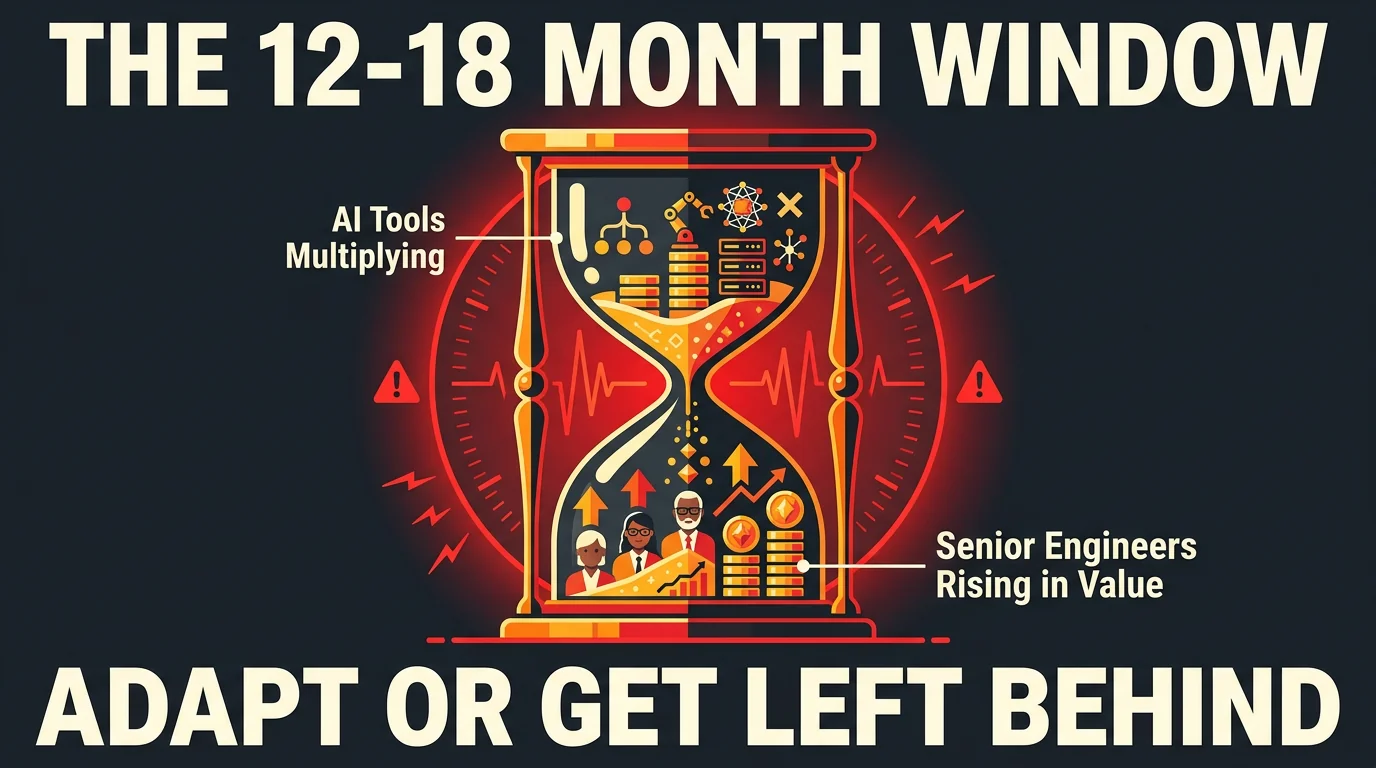
The software development industry is in the middle of a transformation that most teams haven’t fully grasped yet. AI coding tools are improving at a rate that makes the next 12-18 months critical for anyone building software.
This isn’t about AI replacing developers. It’s about AI commoditizing certain types of development work while making other types more valuable. The teams that adapt will thrive. The teams that don’t will find themselves competing on price against AI-assisted competitors.
Here’s what’s happening and why speed matters.
The Current State
AI coding tools have reached an inflection point. According to Stack Overflow’s 2025 Developer Survey, over 70% of developers are using AI tools in their workflow. The productivity gains are real but uneven.
What AI Does Well
| Capability | Current State |
|---|---|
| Code generation | Good at common patterns, struggles with novel problems |
| Documentation | Excellent at explaining code and generating docs |
| Test writing | Good coverage, variable quality on edge cases |
| Refactoring | Strong at mechanical transformations |
| Bug fixing | Good at obvious bugs, misses subtle issues |
| Architecture | Weak at system-level decisions |
What AI Doesn’t Do Well
| Capability | Current State |
|---|---|
| Understanding context | Doesn’t know your business requirements |
| Making trade-offs | Can’t weigh business priorities |
| Novel solutions | Rehashes training data patterns |
| Code review judgment | Can’t evaluate “good enough” vs “perfect” |
| Integration complexity | Struggles with how systems fit together |
The gap between what AI does well and what requires human judgment is where value is shifting.
The Bifurcation Effect
The market for software development is splitting into two segments.
Segment 1: Commodity Development
Characteristics:
- Well-defined requirements
- Common patterns and frameworks
- Similar to existing solutions
- Low complexity, low risk
What’s happening: AI tools can handle 60-80% of this work. Developers using AI are 2-3x more productive. The cost of commodity development is dropping rapidly.
Who’s affected: Teams that specialize in “we build CRUD apps” without deeper expertise.
Segment 2: High-Value Development
Characteristics:
- Novel problems requiring judgment
- Complex integrations and trade-offs
- Domain-specific requirements
- High-stakes reliability needs
What’s happening: AI amplifies senior developers but doesn’t replace the judgment they provide. The value of senior expertise is increasing because AI can execute their ideas faster.
Who’s thriving: Teams with deep domain expertise, architectural experience, and the ability to navigate complexity.
Why 12-18 Months Matters
The window is driven by two factors: AI capability improvement and market adaptation.
AI Capability Trajectory
| Timeline | Expected Capability |
|---|---|
| Now | Good at common patterns, needs guidance |
| 6 months | Better at context, fewer hallucinations |
| 12 months | Strong integration capabilities, better judgment |
| 18 months | Handles most commodity work autonomously |
This isn’t speculative. The improvement from GPT-4 to Claude 4 to Gemini 2 shows the pace. Each generation handles more complex tasks with less guidance.
Market Adaptation Lag
The market takes time to adapt to technology shifts:
| Phase | Timeline | What Happens |
|---|---|---|
| Early adoption | Now - 6 months | Leading teams integrate AI, gain advantage |
| Awareness | 6-12 months | Most teams realize they need to adapt |
| Competition | 12-18 months | AI-assisted becomes the baseline |
| Differentiation | 18+ months | Only high-value expertise commands premium |
Teams that wait 18 months to adapt will be competing against AI-assisted competitors who’ve been refining their process for a year.
The Senior Developer Premium
Counterintuitively, AI is increasing the value of senior developers.
Why Senior Expertise Matters More
| Factor | Pre-AI | Post-AI |
|---|---|---|
| Code volume | Seniors wrote more | AI writes more, humans direct |
| Pattern knowledge | Seniors knew more patterns | AI knows patterns, seniors choose which to apply |
| Debugging skill | Seniors found bugs faster | AI finds surface bugs, seniors find root causes |
| Architecture | Seniors designed systems | Seniors design, AI implements |
| Judgment | Seniors had better judgment | Judgment is now the primary differentiator |
When AI handles implementation, the value shifts to deciding what to implement and how to architect it. That’s senior expertise.
Data Point: Rising Salaries
According to hiring data, senior developer salaries have risen significantly while junior positions have contracted:
| Role | 2022 | 2025 | Change |
|---|---|---|---|
| Senior Engineer | $150K | $190K | +27% |
| Staff/Principal | $200K | $280K | +40% |
| Junior Engineer | $80K | $75K | -6% |
The market is pricing senior judgment at a premium while commoditizing entry-level work.
What This Means for Development Teams
For Service Providers
If you’re building software for clients:
| Strategy | Why It Works |
|---|---|
| Lead with expertise, not capacity | Clients need judgment, not just hands |
| Price for outcomes, not hours | Hourly billing penalizes AI efficiency |
| Invest in senior talent | Juniors need more guidance than AI provides |
| Build domain expertise | Generic skills compete with AI |
| Offer AI governance | Help clients use AI safely |
For In-House Teams
If you’re building your own product:
| Strategy | Why It Works |
|---|---|
| Accelerate with AI | You have 12-18 months of advantage |
| Hire seniors over juniors | One senior + AI outperforms three juniors |
| Focus on product judgment | Implementation is cheaper, deciding what to build is harder |
| Build verification processes | AI makes mistakes; catch them early |
| Document architecture decisions | AI can’t maintain what it doesn’t understand |
The Adaptation Path
Phase 1: Integration (Months 1-3)
| Action | Outcome |
|---|---|
| Adopt AI coding tools | Familiarity with capabilities and limits |
| Establish verification practices | Catch AI mistakes before production |
| Train team on AI workflows | Shared practices across team |
| Measure productivity changes | Data-driven process improvement |
Phase 2: Optimization (Months 4-9)
| Action | Outcome |
|---|---|
| Refine prompts and workflows | Consistent quality from AI assistance |
| Restructure code review | Focus AI review on what it does well |
| Adjust team composition | Shift toward senior-heavy teams |
| Update estimation practices | Account for AI-assisted velocity |
Phase 3: Differentiation (Months 10-18)
| Action | Outcome |
|---|---|
| Market expertise over capacity | Clear positioning against commodity providers |
| Build AI governance services | New offering for clients using AI |
| Establish thought leadership | Visibility as AI-era development partner |
| Long-term client partnerships | Value extends beyond single projects |
The Risk of Waiting
Teams that don’t adapt face a predictable pattern:
| Timeline | What Happens |
|---|---|
| Now | Business as usual, AI adoption optional |
| 6 months | Competitors using AI are 2x faster |
| 12 months | Price pressure from AI-assisted providers |
| 18 months | Losing bids to faster, cheaper competitors |
| 24+ months | Difficulty competing on any dimension |
The risk isn’t AI replacing your job. It’s AI-assisted competitors replacing your business.
Common Mistakes
| Mistake | Why It’s Costly |
|---|---|
| Ignoring AI tools | Falling behind on productivity |
| Trusting AI completely | Quality issues from unverified code |
| Firing juniors without plan | Pipeline for senior talent breaks |
| Competing on price | AI makes commodity development cheap |
| Waiting to see | Adaptation takes time you won’t have |
The next 12-18 months will determine which development teams thrive in the AI era and which struggle to compete. If you’re looking for a development partner who’s already adapted to AI-augmented workflows, book a consultation. We’ve integrated AI tools while maintaining the senior-led judgment that complex projects require.