The AI Orchestrator: Software Engineering's New Role
Andrej Karpathy called it 'LLM orchestration': the emerging role of directing AI tools to build software. Here's what this new engineering discipline looks like in practice.
Jason Overmier
Innovative Prospects Team
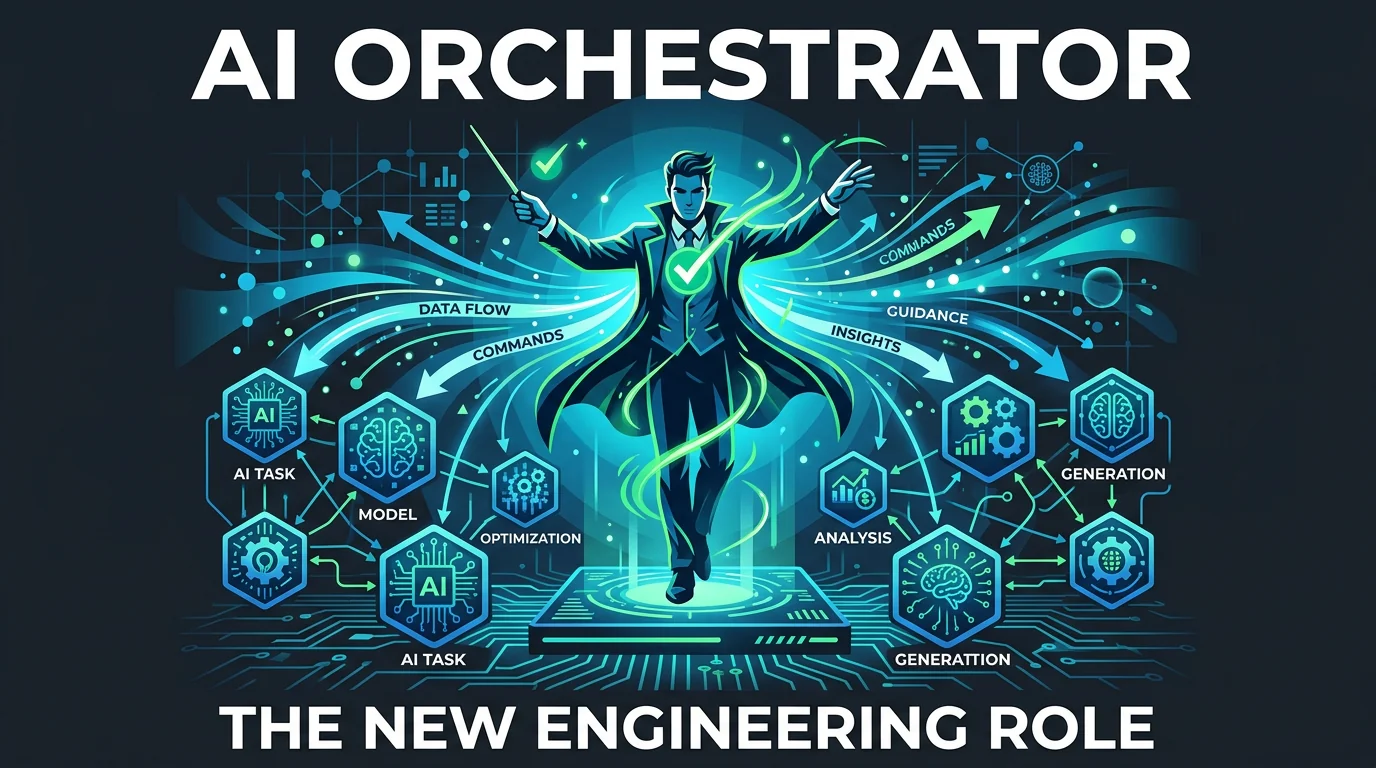
Andrej Karpathy, former Tesla AI director and OpenAI researcher, has been articulating a vision for the future of software engineering that’s worth understanding. He calls it “LLM orchestration”: the discipline of directing AI models to build software rather than writing code directly.
This isn’t about AI replacing developers. It’s about developers shifting from writing code to orchestrating AI systems that write code. The skills that matter are changing, and the engineers who adapt early will have significant advantages.
Here’s what the AI Orchestrator role looks like in practice.
What Is AI Orchestration?
The Traditional Developer Role
Traditional software engineering involves:
| Activity | Time Allocation |
|---|---|
| Writing code | 40% |
| Reading code | 20% |
| Debugging | 20% |
| Planning/designing | 15% |
| Communication | 5% |
The primary activity is directly producing code.
The Orchestrator Role
AI orchestration shifts the allocation:
| Activity | Time Allocation |
|---|---|
| Prompting and directing AI | 25% |
| Reviewing AI output | 30% |
| Debugging and verification | 20% |
| Planning/designing | 20% |
| Communication | 5% |
The primary activity is directing and verifying AI-generated code.
The Key Difference
| Aspect | Traditional | Orchestrator |
|---|---|---|
| Output mechanism | Write code | Prompt AI to write code |
| Quality control | Self-review | Verify AI output |
| Expertise needed | Syntax, patterns, libraries | System design, requirements, judgment |
| Scalability | Limited by typing speed | Limited by orchestration ability |
The orchestrator doesn’t need to know every API detail. They need to know what they want and verify they got it.
Skills for AI Orchestration
Core Capabilities
| Skill | Why It Matters | How to Develop |
|---|---|---|
| Requirements decomposition | AI needs clear direction | Practice breaking down features into atomic prompts |
| System architecture | AI generates code, not systems | Study design patterns, trade-offs |
| Code review | AI makes subtle errors | Practice catching AI-specific mistakes |
| Prompt engineering | Better prompts, better output | Experiment with different prompting strategies |
| Verification design | Trust requires proof | Build comprehensive test suites |
The Prompting Skill
Effective prompting is more nuanced than asking nicely:
| Prompt Element | Purpose | Example |
|---|---|---|
| Context | Frame the problem | ”In a Next.js app using App Router…” |
| Constraints | Define boundaries | ”Use TypeScript, no external dependencies” |
| Examples | Show desired pattern | ”Follow this pattern: [example code]“ |
| Edge cases | Specify handling | ”Handle null values by returning empty array” |
| Quality bar | Set expectations | ”Include error handling and JSDoc comments” |
A well-structured prompt produces better output than a vague request.
The Verification Skill
AI-generated code requires different verification than human-written code:
| Verification Type | What to Check | Why AI Needs It |
|---|---|---|
| Functional correctness | Does it do what was asked? | AI may misunderstand requirements |
| API accuracy | Do imported functions exist? | AI hallucinates APIs |
| Edge cases | Does it handle corner cases? | AI often misses edge cases |
| Security | Any vulnerabilities? | AI trained on vulnerable code |
| Performance | Will it scale? | AI optimizes for correctness, not performance |
The Orchestration Workflow
A Practical Example
Building a feature with AI orchestration:
Step 1: Decompose the Feature
Instead of prompting for the whole feature, break it down:
Feature: User notification preferences

Components needed:
1. Database schema for preferences
2. API endpoints (GET, PUT)
3. React form component
4. Integration with notification service
5. Tests for each component
Step 2: Prompt Each Component
Create a PostgreSQL schema for user notification preferences.

Requirements:
- User ID (foreign key to users table)
- Email notifications (boolean, default true)
- Push notifications (boolean, default true)
- Notification categories (JSON for flexibility)
- Created/updated timestamps

Output: SQL migration file with comments
Step 3: Review Output
-- AI output
CREATE TABLE notification_preferences (
  id SERIAL PRIMARY KEY,
  user_id INTEGER REFERENCES users(id) ON DELETE CASCADE,
  email_enabled BOOLEAN DEFAULT true,
  push_enabled BOOLEAN DEFAULT true,
  categories JSONB DEFAULT '{}',
  created_at TIMESTAMP DEFAULT NOW(),
  updated_at TIMESTAMP DEFAULT NOW()
);

-- Review: Looks correct, but missing unique constraint on user_id
-- Fix: Add UNIQUE constraint to prevent duplicate preferences
Step 4: Iterate and Verify
Continue for each component, verifying as you go. Run tests after each piece.
Orchestrator vs. Writer Output
| Metric | Direct Writing | Orchestration |
|---|---|---|
| Time to first draft | Longer | Shorter |
| Time to production | Variable | Often faster (with good verification) |
| Code consistency | Variable | Higher (AI is consistent) |
| Bug types | Mixed | Subtle, harder to find |
| Knowledge captured | In developer’s head | In prompts and documentation |
The Economics of Orchestration
Productivity Calculation
For a typical feature:
| Approach | Write Time | Review Time | Debug Time | Total |
|---|---|---|---|---|
| Direct writing | 4 hours | 1 hour | 1 hour | 6 hours |
| Orchestration | 1 hour | 2 hours | 1.5 hours | 4.5 hours |
Orchestration wins when:
- Review skills are strong
- Verification is systematic
- Prompts are well-structured
When Orchestration Loses
| Scenario | Why Orchestration Struggles |
|---|---|
| Novel algorithms | AI doesn’t know the approach |
| Domain-specific logic | AI lacks context |
| Legacy system integration | AI doesn’t know your codebase history |
| Performance-critical code | AI optimizes for correctness |
| Security-sensitive code | AI may introduce vulnerabilities |
The orchestrator must recognize when to write directly.
Building an Orchestrator Team
Team Composition
| Role | Count (10-person team) | Focus |
|---|---|---|
| Senior Orchestrators | 4 | Architecture, complex features |
| Mid-level Orchestrators | 4 | Standard features, verification |
| Junior Developers | 2 | Learning, simple tasks (limited) |
The pyramid inverts toward senior-heavy teams.
Interview Criteria
When hiring for orchestration skills:
| Assess For | How to Test |
|---|---|
| Decomposition | Give vague feature, evaluate breakdown |
| Prompting | Review their prompts for an AI-assisted task |
| Verification | Debug AI-generated code with subtle errors |
| Judgment | When would they write directly vs. orchestrate? |
Training Existing Developers
| Phase | Focus | Duration |
|---|---|---|
| 1: Tool familiarization | Basic AI tool usage | 1-2 weeks |
| 2: Prompting practice | Effective prompt construction | 2-4 weeks |
| 3: Verification rigor | Catching AI errors | 2-4 weeks |
| 4: Workflow integration | Full orchestration workflow | 1-2 months |
The Future of the Role
Near Evolution (1-2 Years)
| Change | Impact |
|---|---|
| Better AI context | Less decomposition needed |
| Integrated tools | Smoother workflow |
| Standardization | Established best practices |
| Certification | Formal recognition of skills |
Medium Evolution (3-5 Years)
| Change | Impact |
|---|---|
| Agent-based development | AI handles more autonomously |
| Reduced code review | Higher AI reliability |
| Shift to design focus | Less code, more architecture |
| New specializations | Domain-specific orchestration |
Long Evolution (5+ Years)
The role may converge with product management, system design, or split into new specializations entirely. The one constant: human judgment remains valuable even as implementation becomes automated.
Common Mistakes
| Mistake | Why It Hurts |
|---|---|
| Trusting AI completely | Subtle bugs reach production |
| Poor prompting | More revision time negates speed gains |
| Skipping verification | AI errors compound |
| Orchestrating everything | Some code is faster to write directly |
| Not documenting prompts | Knowledge isn’t captured |
AI orchestration is becoming a core engineering skill. If you’re looking for a development partner who understands both the power and limitations of AI-assisted development, book a consultation. We’ve built orchestration into our workflow while maintaining the verification rigor production systems require.