Three AI Scenarios for 2026-2027: How We're Positioned for All
AI development could accelerate, plateau, or retreat. Our strategy works across all three scenarios. Here's how to build a development approach that doesn't depend on predictions.
Jason Overmier
Innovative Prospects Team
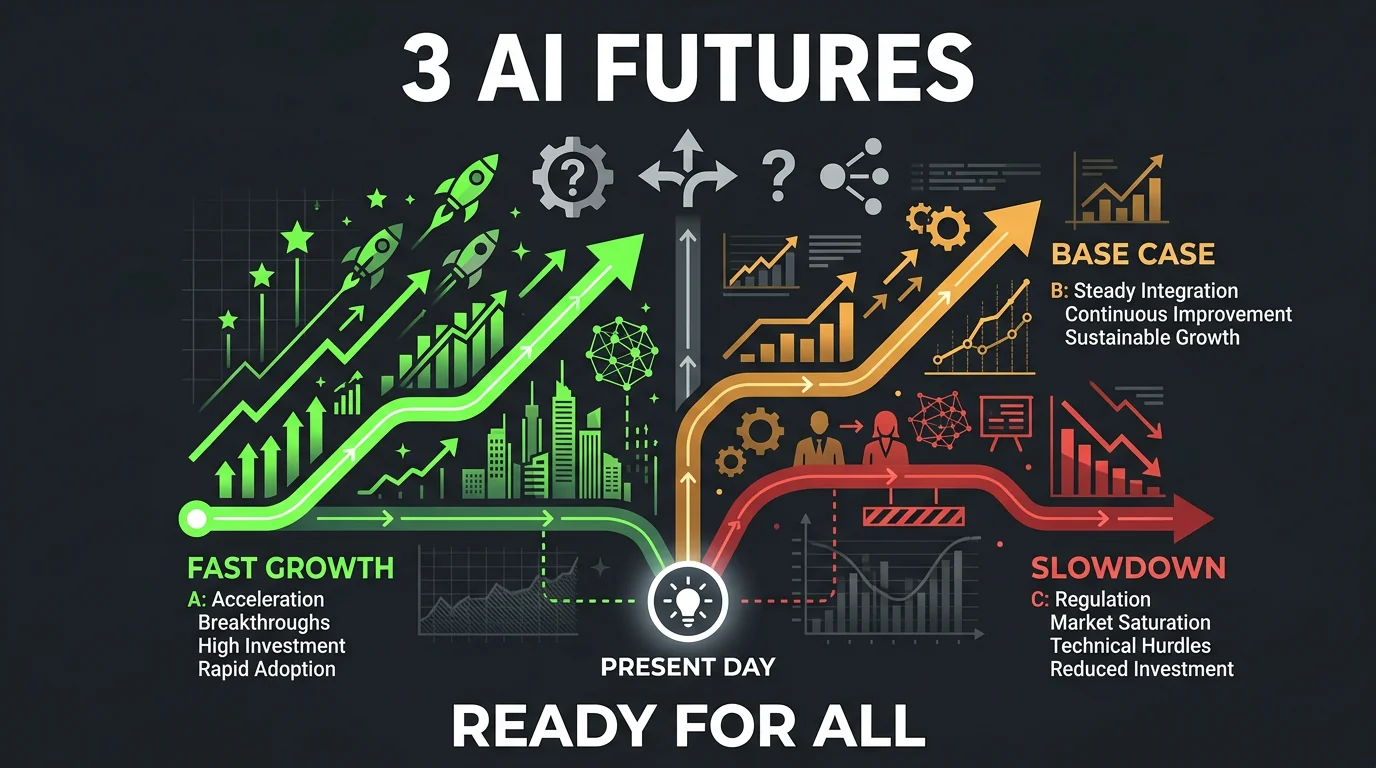
Predicting AI’s trajectory is a fool’s errand. The technology could continue its rapid improvement, hit a plateau, or even regress due to data exhaustion or regulatory constraints. Each scenario has smart people arguing for it.
Rather than betting on a single outcome, we’ve built a strategy that works across scenarios. This approach doesn’t require predicting the future. It requires building capabilities that have value regardless of what happens.
Here are the three scenarios and how to position for each.
Scenario 1: Continued Acceleration
What it assumes: AI capabilities improve at current or accelerated pace through 2027.
Indicators This Is Happening
| Indicator | What to Watch |
|---|---|
| Model improvements | Each generation significantly outperforms previous |
| Context expansion | Models handle larger codebases with better understanding |
| Agent capabilities | AI can complete multi-step tasks with minimal guidance |
| Error reduction | Hallucination rates continue to drop |
| Adoption acceleration | AI tool usage grows beyond current 70% |
Implications for Development
| Area | Impact |
|---|---|
| Routine coding | Largely automated |
| Code review | AI handles most checks |
| Testing | AI generates comprehensive test suites |
| Architecture | AI assists with design decisions |
| Junior roles | Further contraction |
How to Position
| Strategy | Why It Works |
|---|---|
| AI-native workflows | Already optimized for AI assistance |
| Verification focus | AI still makes mistakes that need catching |
| Senior expertise | Judgment remains valuable |
| Fast iteration | Speed advantage from AI adoption |
Scenario 2: Plateau
What it assumes: AI improvement slows significantly. Models get incrementally better but don’t achieve step-function gains.
Indicators This Is Happening
| Indicator | What to Watch |
|---|---|
| Diminishing returns | New models offer marginal improvements |
| Persistent errors | Hallucination rates stabilize |
| Context limits | Models still struggle with large codebases |
| Adoption saturation | Growth in AI tool usage slows |
| Compute constraints | Training costs limit model improvements |
Implications for Development
| Area | Impact |
|---|---|
| Routine coding | AI handles 40-60% (current levels) |
| Code review | Human review still essential |
| Testing | AI assists but doesn’t replace strategy |
| Architecture | Human judgment required |
| Junior roles | Stabilize at reduced levels |
How to Position
| Strategy | Why It Works |
|---|---|
| Balanced AI usage | Use AI where it helps, don’t depend on improvement |
| Human expertise | Core value remains human judgment |
| Traditional skills | Maintain ability to work without AI |
| Selective AI adoption | Proven use cases only |
Scenario 3: Slowdown or Regression
What it assumes: AI hits significant barriers. Data quality issues, regulatory constraints, or technical limits cause capabilities to stagnate or decline.
Indicators This Is Happening
| Indicator | What to Watch |
|---|---|
| Model quality issues | New models perform worse on some tasks |
| Data contamination | Training data quality degrades |
| Regulatory barriers | Significant restrictions on training or use |
| Cost escalation | Running costs make tools uneconomical |
| Adoption reversal | Companies reduce AI tool usage |
Implications for Development
| Area | Impact |
|---|---|
| Routine coding | Reverts to human-heavy approach |
| Code review | Traditional review processes |
| Testing | Human test design |
| Architecture | Pure human judgment |
| Junior roles | Potential recovery |
How to Position
| Strategy | Why It Works |
|---|---|
| Maintained fundamentals | Can operate without AI tools |
| Traditional development | Not dependent on AI |
| Balanced team | Can scale human capacity |
| Tool flexibility | Not locked into AI workflows |
The Scenario-Proof Strategy
The strategies above differ, but a core set of capabilities works across all scenarios:
Universal Capabilities
| Capability | Why It Works in All Scenarios |
|---|---|
| Senior expertise | Judgment is valuable whether AI is weak or strong |
| Verification rigor | Needed if AI makes mistakes or isn’t available |
| Architecture skills | System design matters regardless of implementation method |
| Domain knowledge | Context is valuable with or without AI |
| Communication | Translating business needs to technical solutions is always needed |
Scenario-Dependent Capabilities
| Capability | Valuable In | Less Valuable In |
|---|---|---|
| AI prompting | Acceleration, plateau | Slowdown |
| Traditional coding | Slowdown | Acceleration |
| AI tool operations | Acceleration, plateau | Slowdown |
| Large team management | Slowdown | Acceleration |
Our Approach
We’ve built our practice around capabilities that matter regardless of scenario:
| Focus Area | How It’s Scenario-Proof |
|---|---|
| Senior-led teams | Judgment is always valuable |
| AI-augmented workflow | Works in acceleration and plateau, optional in slowdown |
| Verification processes | Needed regardless of how code is produced |
| Domain expertise | Valuable in all scenarios |
| Architecture-first thinking | Implementation method doesn’t change design value |
What We’re Not Doing
Some strategies are fragile to scenario changes:
Fragile Strategy 1: AI Dependency
The approach: Build everything assuming AI will handle it.
Risk: If AI plateaus or regresses, you can’t deliver.
Why we avoid it: We maintain ability to work without AI tools when needed.
Fragile Strategy 2: AI Denial
The approach: Ignore AI tools, build the same way as 2020.
Risk: If AI continues to improve, you’re uncompetitive on speed and cost.
Why we avoid it: We’ve integrated AI tools where they provide value.
Fragile Strategy 3: Junior Mill
The approach: Hire many juniors, expect them to learn and scale.
Risk: Works only in slowdown scenario. In other scenarios, juniors provide less leverage.
Why we avoid it: We’re senior-heavy, which works in all scenarios.
Monitoring for Scenario Shifts
We track indicators to adjust our approach:
| What We Track | What It Tells Us |
|---|---|
| AI tool capability | Is the acceleration scenario playing out? |
| Client expectations | Are they expecting AI-accelerated delivery? |
| Competitor offerings | Are others gaining advantage from AI? |
| Team productivity data | Is AI usage actually improving our output? |
| Quality metrics | Is AI affecting our defect rates? |
Adjustment Triggers
| If We See | We Adjust By |
|---|---|
| Accelerating AI capability | More aggressive AI integration |
| Plateau signs | Balance AI usage with traditional skills |
| Slowdown signals | Reduce AI dependency, invest in traditional capabilities |
Client Guidance
For clients planning projects, we recommend scenario-proof thinking:
Questions to Ask
| Question | Why It Matters |
|---|---|
| ”How would you deliver if AI tools became unavailable?” | Tests for AI dependency |
| ”What’s your verification process for AI-generated code?” | Quality shouldn’t depend on AI quality |
| ”How does your team composition change in different scenarios?” | Tests for flexibility |
Red Flags
| Red Flag | The Risk |
|---|---|
| 100% AI dependency | Delivery risk in slowdown |
| No verification process | Quality risk in any scenario |
| Junior-heavy team | Leverage risk if AI improves |
| Fixed predictions | Fragile to being wrong |
Common Mistakes
| Mistake | Why It’s Costly |
|---|---|
| Betting on a single scenario | If wrong, strategy fails |
| Ignoring AI entirely | Miss acceleration benefits |
| Depending entirely on AI | Fragile to plateau or slowdown |
| Not monitoring indicators | Can’t adjust in time |
| Over-optimizing for one future | Loses flexibility |
The future of AI is uncertain, but your strategy doesn’t have to be. If you’re looking for a development partner who’s prepared for multiple futures, book a consultation. We’ve built capabilities that work whether AI accelerates, plateaus, or slows down.