Build vs Buy for Core Features: A Startup Decision Framework
Every feature decision is a build vs buy choice. Here's a framework for deciding when custom development pays off and when third-party services make more sense.
Jason Overmier
Innovative Prospects Team
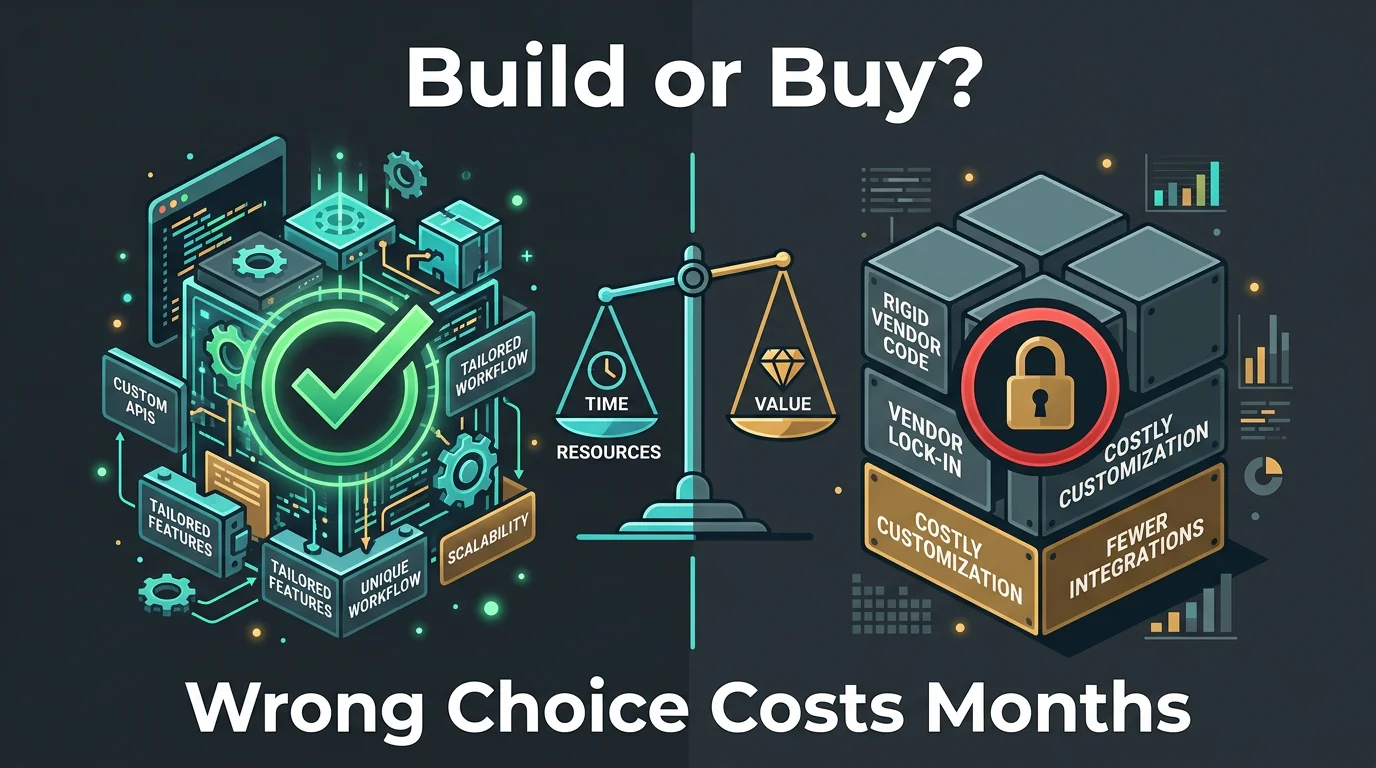
Your startup needs authentication, payments, email delivery, analytics, file storage, and a dozen other features. For each one, you face the same question: build it yourself or integrate a third-party service?
The answer isn’t obvious. Build too much and you’ll never ship. Buy too much and you’ll hit a ceiling when your needs diverge from what the service provides.
Here’s a framework for making these decisions systematically.
Quick Answer
| Feature Type | Recommendation | Why |
|---|---|---|
| Commodity infrastructure | Buy | Auth, payments, email, storage are solved problems |
| Core differentiator | Build | Your competitive advantage shouldn’t depend on a vendor |
| Complex with low differentiation | Buy + customize | Search (Algolia), maps (Mapbox), video (Mux) |
| Simple but strategic | Build | When you need full control over the experience |
| Uncertain requirements | Buy first | Switch to build if you hit limitations |
The pattern: Buy commodities, build differentiators, stay flexible on everything else.
The Build vs Buy Spectrum
This isn’t a binary choice. Features fall on a spectrum from “obviously buy” to “obviously build.”
Obviously Buy (Commodity Layer)
| Feature | Services | Why Buy |
|---|---|---|
| Authentication | Auth0, Clerk, Supabase Auth | Security is critical, UX is standardized |
| Payments | Stripe, PayPal | Compliance is complex, APIs are mature |
| Email delivery | Resend, Postmark, SendGrid | Deliverability is hard, features are standard |
| File storage | S3, Cloudflare R2 | Infrastructure is solved, scale matters |
| Logging/monitoring | Datadog, Sentry | Setup is fast, value is immediate |
These features have no competitive advantage. Your users don’t care who handles your authentication. They expect it to work. Spending engineering time here is almost always a mistake.
Obviously Build (Differentiator Layer)
| Feature | Why Build |
|---|---|
| Core product logic | This IS your product |
| Novel algorithms | Your IP, your competitive advantage |
| Unique workflows | Standard solutions won’t fit |
| Domain-specific processing | No vendor understands your space |
If this feature is why customers choose you over competitors, build it. Depending on a vendor for your core value is renting your competitive advantage.
The Gray Zone (Context-Dependent)
| Feature | Buy If… | Build If… |
|---|---|---|
| Search | Standard search works | Relevance is a differentiator |
| Notifications | Basic push/email is enough | Complex rules, preferences, timing |
| Analytics | Standard metrics suffice | Custom metrics drive your business |
| Chat/messaging | Basic messaging works | Real-time, threading, moderation are core |
| Scheduling | Standard calendar integration | Complex availability, booking logic |
This is where the framework matters. The right answer depends on your specific context.
Decision Framework
For each feature decision, evaluate these factors:
1. Strategic Importance
Question: Does this feature differentiate us from competitors?
| Score | Meaning | Recommendation |
|---|---|---|
| 1-2 | Commodity, no differentiation | Strong buy |
| 3 | Some customization needed | Buy + customize |
| 4-5 | Core to our value proposition | Strong build |
2. Complexity vs. Customization
Question: How complex is this to build vs. how much customization do we need?
| Low Complexity, Low Customization | High Complexity, Low Customization |
|---|---|
| Buy (why build something easy that you don’t need to customize?) | Buy (let specialists handle complexity) |
| Low Complexity, High Customization | High Complexity, High Customization |
|---|---|
| Build (easy to do exactly what you want) | Toughest case: Start with buy, plan to build if needed |
3. Time-to-Market Pressure
Question: How quickly do we need this?
| Timeline | Lean Toward |
|---|---|
| Weeks | Buy (integration takes hours/days) |
| Months | Either is viable |
| No hard deadline | Build if strategically important |
Speed matters more in early stages. You can always build later when you have product-market fit.
4. Vendor Risk Assessment
Question: What happens if the vendor changes pricing, goes down, or shuts down?
| Risk Level | Characteristics | Approach |
|---|---|---|
| Low | Multiple alternatives, easy migration, stable pricing | Buy confidently |
| Medium | Some lock-in, migration would take weeks | Buy with abstraction layer |
| High | Single vendor, proprietary data formats, critical path | Build or multi-vendor strategy |
5. Total Cost Analysis
Question: What’s the real cost of each option?
Buy costs:
- Integration time (usually days to weeks)
- Monthly fees (often scaling with usage)
- Migration costs when you outgrow
- Opportunity cost of vendor limitations
Build costs:
- Development time (weeks to months)
- Ongoing maintenance (forever)
- Infrastructure and scaling
- Security and compliance burden
Common Mistakes
| Mistake | Why It Happens | The Cost |
|---|---|---|
| Building commodities | ”How hard can it be?” | Weeks wasted on solved problems |
| Buying differentiators | ”We’ll customize later” | You won’t, and you’ll be limited |
| Ignoring vendor lock-in | ”We can always switch” | Migration costs 10x what you expect |
| Over-engineering the abstraction | ”We might switch vendors” | Generic code that satisfies no one |
| Deciding once, never revisiting | Early decisions become permanent | You’re stuck with suboptimal choices |
The Abstraction Layer Strategy
When you buy, add a thin abstraction layer. This gives you flexibility without over-engineering.
// Bad: Direct vendor calls scattered everywhere
await stripe.charges.create({ amount: 2000, ... });

// Good: Abstraction layer
interface PaymentProcessor {
  charge(amount: number, customerId: string): Promise<ChargeResult>;
  refund(chargeId: string): Promise<RefundResult>;
}

class StripeProcessor implements PaymentProcessor {
  // Implementation details isolated here
}

// Usage (vendor-agnostic)
paymentProcessor.charge(2000, customerId);
This pattern lets you switch vendors without rewriting your entire codebase. But don’t overdo it: build the abstraction you need today, not every possible feature you might need.
Real Examples
Example 1: Authentication for a B2B SaaS
Context: Building a B2B dashboard for enterprise clients. Need SSO, role-based access, and audit logs.
Analysis:
- Strategic importance: Low (users expect standard auth)
- Complexity: High (SSO, SCIM, audit logs)
- Time pressure: Moderate
- Vendor risk: Low (Auth0, Clerk, Supabase all viable)
Decision: Buy (Clerk or Auth0)
Why: Auth complexity explodes quickly. SSO integrations, session management, and security updates are a full-time job. Your engineers should focus on the product.
Example 2: Recommendation Engine for E-commerce
Context: Building a niche marketplace. Product recommendations are a key differentiator.
Analysis:
- Strategic importance: High (better recommendations = more sales)
- Complexity: Medium (basic ML, not cutting-edge)
- Time pressure: Moderate
- Vendor risk: Medium (recommendations are core to product)
Decision: Build (with optional vendor for initial training data)
Why: Generic recommendation APIs won’t understand your niche market. The algorithm IS the product. Start simple, improve over time.
Example 3: Real-time Chat for a Collaboration Tool
Context: Building a project management tool. Chat is a feature, not the core product.
Analysis:
- Strategic importance: Medium (users expect it, but not a differentiator)
- Complexity: High (real-time, presence, history, search)
- Time pressure: High (competitors have it)
- Vendor risk: Medium (migration would be painful)
Decision: Buy first (Stream, Pusher, or similar), plan to build if it becomes strategic
Why: Real-time infrastructure is complex. Ship fast with a vendor. If chat becomes central to your product (unlikely based on positioning), build later.
When to Revisit Build vs Buy
Early decisions aren’t permanent. Re-evaluate when:
- Vendor pricing changes significantly - The calculus shifts
- You hit vendor limitations repeatedly - Workarounds are piling up
- The feature becomes strategic - What was commodity is now differentiator
- You have excess engineering capacity - Build debt becomes addressable
- The vendor’s direction diverges from yours - Their roadmap doesn’t serve you
Common Pitfalls
| Pitfall | Why It Happens | Fix |
|---|---|---|
| Building for resume-driven development | Engineers want to learn new tech | Build only what serves the business |
| Buying without reading docs | ”We’ll figure it out” | POC the integration before committing |
| Abandoning vendor too early | ”We’re hitting limits” | Are they real limits or implementation issues? |
| Staying with vendor too long | ”Migration is too hard” | Compound interest on technical debt |
| No clear ownership | ”Who decided this?” | Document decisions and rationale |
Decision Template
For each significant feature, document:
## Feature: [Name]

**Decision:** Build / Buy ([Vendor])
**Date:** YYYY-MM-DD
**Revisit by:** YYYY-MM-DD (or trigger event)

### Factors
- Strategic importance: [1-5]
- Complexity: [Low/Medium/High]
- Time pressure: [Weeks/Months/None]
- Vendor risk: [Low/Medium/High]

### Rationale
[2-3 sentences on why this decision makes sense]

### Alternatives Considered
[What else you evaluated]
This creates a paper trail for future team members and forces explicit reasoning.
The build vs buy decision shapes your product architecture, team focus, and long-term flexibility. If you’re planning a new product and want guidance on which features to build vs buy, book a consultation. We’ve helped dozens of startups make these decisions, and we’re happy to share what we’ve learned.