Custom Software vs No-Code: When to Use Each for Your MVP
Should you build custom software or use a no-code platform? Here's a practical framework based on complexity, differentiation, and long-term scalability.
Jason Overmier
Innovative Prospects Team
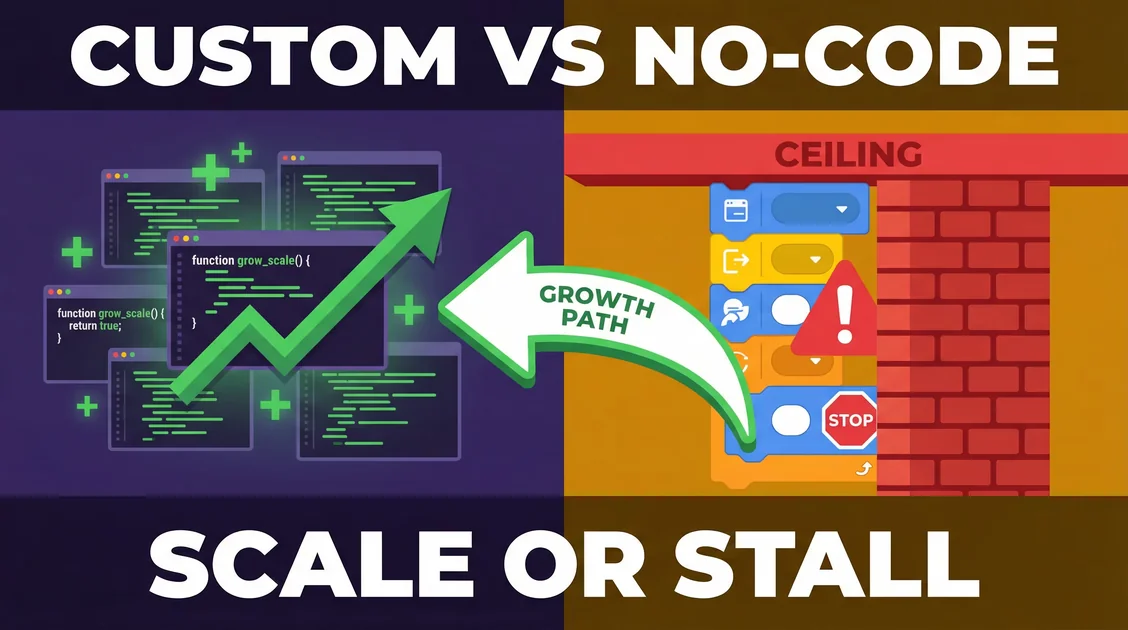
Custom Software vs No-Code: When to Use Each for Your MVP
You have an idea for a software product. The question is: do you hire developers to build custom software, or use a no-code platform to get something running fast?
No-code platforms have exploded in capability. You can build marketplaces, SaaS applications, and internal tools without writing a single line of code. But no-code isn’t magic. It has limitations that could stall your growth if you hit them at the wrong time.
Quick Answer
For internal tools, MVPs with standard functionality, and proof-of-concept testing, no-code is often the right starting point: faster, cheaper, and sufficient for validation. For products with complex logic, unique workflows, or scalability requirements, custom software is the better long-term investment.
The key is knowing which path matches your stage, complexity, and differentiation needs. Many successful products start on no-code and migrate to custom software when the time is right.
Comparison Table
| Factor | Custom Software | No-Code | Winner |
|---|---|---|---|
| Time to Launch | 8-16 weeks (typical MVP) | 1-4 weeks | No-Code |
| Cost (Initial) | $15K-$100K+ | $0-$500/month | No-Code |
| Cost (Scale) | Marginal cost is low | Cost scales with users | Custom |
| Customization | Unlimited (anything is possible) | Limited to platform capabilities | Custom |
| Scalability | High (architected for scale) | Limited by platform constraints | Custom |
| Differentiation | High (unique features are possible) | Low (same platform as competitors) | Custom |
| Maintenance | Requires developers | Platform handles updates | No-Code |
| Data Ownership | Full control | Platform-dependent | Custom |
| Exit Strategy | Own IP, saleable | Migration can be complex | Custom |
| Technical Debt | Accumulates over time | Hidden in platform limitations | Tie |
| Time to Change | Slower (requires dev work) | Faster (configuration changes) | No-Code |
Overall: No-Code wins for speed and initial cost. Custom Software wins for scalability, differentiation, and long-term value.
When to Choose No-Code
No-code excels in these scenarios:
Best For
- Internal tools - CRMs, admin panels, internal dashboards
- Standard business workflows - Simple marketplaces, directories, booking systems
- MVP validation - Testing if people want your solution before investing heavily
- Non-technical founders - You need to ship something without hiring developers
- Budget-constrained projects - You have less than $15K to spend
Key Advantages
| Advantage | Why It Matters |
|---|---|
| Speed - Launch in weeks, not months | Validate ideas quickly |
| Low upfront cost - Monthly subscription vs. upfront development | Preserves cash for other priorities |
| Visual development - See what you build | Easier for non-technical founders |
| Built-in features - Auth, payments, database included | Don’t reinvent the wheel |
| Maintenance included - Platform handles updates, security | No developer needed for upkeep |
Trade-offs to Consider
- Platform limitations - You’re constrained by what the platform supports
- Scaling costs - Per-user pricing becomes expensive at scale
- Data portability - Exporting data and migrating to custom can be painful
- Competitor exposure - Competitors can use the same platform with similar features
- Limited differentiation - Hard to build unique features or complex logic
- Vendor lock-in - Your product depends on someone else’s platform decisions
Popular No-Code Platforms:
| Platform | Best For | Limitations |
|---|---|---|
| Bubble | Web apps, marketplaces, SaaS | Learning curve, performance at scale |
| Webflow | Marketing sites, simple web apps | Limited application logic |
| Airtable | Databases, simple internal tools | Not for customer-facing products |
| Zapier | Workflow automation, integrations | Not a standalone product builder |
| Glide/Adalo | Simple mobile apps | Limited customization, performance |
Real-World Example
A founder built a simple marketplace connecting local service providers with customers using Bubble. They launched in 3 weeks with $200/month in platform costs. After getting 100 users and validating demand, they raised $50K and hired developers to rebuild a custom version that could handle their specific workflow requirements.
When to Choose Custom Software
Custom software is the better choice when:
Best For
- Complex business logic - Unique algorithms, specialized workflows, complex calculations
- High-scalability requirements - Thousands of concurrent users, heavy data processing
- Differentiation features - Your unique value prop requires custom implementation
- Performance-sensitive applications - Real-time features, complex animations, big data
- Integration-heavy products - Multiple APIs, custom integrations, edge cases
- Funded startups - You have the budget and want to build for the long term
Key Advantages
| Advantage | Why It Matters |
|---|---|
| Unlimited customization - Build exactly what you envision | True differentiation is possible |
| Scalability - Architecture for growth, not platform limits | Handle user growth without hitting walls |
| Performance - Optimized for your specific use case | Better user experience, lower infrastructure costs |
| IP ownership - You own everything, can sell the company | Clear asset value for investors/acquirers |
| Talent flexibility - Not dependent on specific platform expertise | Easier hiring, more control |
| Exit strategy - Clean ownership, easier migration | Clearer path to acquisition |
Trade-offs to Consider
- Higher upfront cost - $15K-$100K+ for MVP development
- Longer time to market - 8-16 weeks typical for MVP
- Ongoing maintenance - Requires developers for updates, bug fixes
- Technical complexity - More moving parts, more that can break
- Need for technical oversight - Even with an agency, you need to understand decisions
Real-World Example
A healthcare startup needed HIPAA-compliant messaging, custom scheduling logic, and integration with electronic health records. No-code platforms couldn’t meet their compliance requirements or handle their complex appointment algorithms. They invested $60K in custom development, launched in 10 weeks, and successfully raised a Series A based on their differentiated product.
The Migration Path: No-Code to Custom
Many successful companies follow this progression:
Stage 1: No-Code MVP (Weeks 1-8)
- Launch on Bubble, Webflow, or similar
- Validate product-market fit
- Gather user feedback
- Cost: $200-$1,000/month
Stage 2: Hybrid Transition (Months 3-6)
- Keep no-code for admin/internal tools
- Build custom for customer-facing features
- Migrate data gradually
- Cost: Platform fee + initial development investment
Stage 3: Full Custom (Months 6-12)
- Complete migration to custom
- Decommission no-code platform
- Own full stack
- Cost: Development + infrastructure (no platform fees)
When to migrate:
| Trigger | Action |
|---|---|
| Platform cost exceeds $2K/month | Consider custom to reduce long-term costs |
| Hitting performance limits | Custom for scalability |
| Need features platform can’t support | Custom for differentiation |
| Preparing for fundraising/funding | Custom for IP ownership |
| Team hires developers | Transition to custom to utilize talent |
Common Pitfalls
| Pitfall | Why It Happens | How to Avoid |
|---|---|---|
| Building a startup on no-code too long | Migration becomes more complex over time | Plan migration before platform limitations become critical |
| Over-building custom software initially | Gold-plating features before validation | Build true MVP, iterate based on feedback |
| Underestimating no-code limitations - Assuming “anything is possible” | Prototype complex features early to test feasibility | |
| Choosing wrong no-code platform | Picking one that can’t grow with you | Research migration options, data export capabilities |
| Poor data structure in no-code - Treating it like a spreadsheet, not a database | Design proper data relationships from the start | |
| Ignoring performance in custom - Focusing on features, not optimization | Performance test early, architecture for scale |
The Decision Framework
Use this framework to decide:
Start with no-code if:
- You’re validating an idea and unsure of demand
- Your product has standard functionality (CRUD, simple workflows)
- You have less than $15K to invest
- You need to launch in under 4 weeks
- You’re non-technical and not ready to hire developers
Start with custom software if:
- Your product has complex or unique logic
- You need to scale to thousands of users quickly
- Performance is critical to your value proposition
- You have $15K-$100K+ budget
- You’ve validated the concept and are ready to build for growth
Hybrid approach if:
- You have some budget but want to move fast ($25K-$50K)
- Some features are standard (no-code) and some are unique (custom)
- You want to validate quickly but plan to scale soon
The Complexity Spectrum
Not all products are equally complex. Use this guide:
Low Complexity (No-Code Suitable):
- Directories and listing sites
- Simple marketplaces (2-sided transactions)
- Content sites and blogs
- Basic CRUD applications
- Simple booking/reservation systems
Medium Complexity (Either Approach):
- Marketplaces with complex matching
- SaaS with subscription billing
- Apps with several integrations
- Social platforms with basic features
- Analytics dashboards
High Complexity (Custom Recommended):
- Real-time collaboration tools
- Complex algorithms or matching logic
- Heavy data processing/analysis
- Applications with heavy compliance requirements (HIPAA, PCI)
- Performance-critical applications
- Products requiring custom integrations at scale
How We Can Help
We help founders make this decision every day. Our MVP Build service starts with a discovery call to assess whether custom software is right for your situation, and if not, we’ll tell you.
For clients who need custom software, we deliver in 8 weeks with a fixed price and clear roadmap.
Book a free consultation to discuss your product idea.
Still unsure whether no-code or custom is right for your MVP? Let’s talk through your specific requirements and timeline.