Equity-for-Services Partnerships: Is It Right for Your Startup?
Cash-strapped startups often ask if we'll work for equity. The question makes sense: you have a compelling vision but limited runway. Trading ownership for development seems like a smart way to extend your resources.
Jason Overmier
Innovative Prospects Team
Cash-strapped startups often ask if we’ll work for equity. The question makes sense: you have a compelling vision but limited runway. Trading ownership for development seems like a smart way to extend your resources.
These partnerships can work. They can also waste everyone’s time. The difference usually comes down to whether the situation fits the model.
Here’s how equity-for-services partnerships actually work, who should consider them, and what both sides should expect.
Quick Answer
| Your Situation | Equity-for-Services? |
|---|---|
| Strong team, validated market, pre-seed | Maybe (depends on partner’s criteria) |
| Idea stage, no validation | No (too much risk for both sides) |
| Post-seed, growing revenue | No (cash is more efficient) |
| Technical founder needs help | Maybe (augmenting existing capacity) |
| Non-technical solo founder | Rarely (too dependent on one relationship) |
The model works best for exceptional pre-seed teams with clear paths to funding.
How Equity-for-Services Works
You trade a percentage of your company for development services:
| You Give | You Get |
|---|---|
| Equity stake (typically 1-5%) | Development work worth the stake |
| Vested over 12-24 months | Full ownership of work product |
What the Partnership Looks like
A Annual cap on your ownership (1-5% of company) “lazy” and the “you”)
-
No cash | but, the otherwise you change would be hard
-
Both parties need similar upside | Alignment on vision and exit strategy, and trust (vesting helps)
-
Full documentation | Code ownership transfers at handoff
-
Equity is at risk | The investor (developer) takes on both
-
Exit provisions | Clear terms for unwinding
Two Types of structures
| Structure | How it works |
|---|---|
| Traditional agency | Developer joins as employee/contractor, gets equity |
| Venture studio | Studio provides team and resources, takes equity |
| Technical co-founder | Experienced developer joins for equity stake |
Most are equity partnerships follow the venture studio model where the firm provides resources in exchange for ownership.
When It Works
For the right startup
| Factor | Why it helps |
|---|---|
| Conserves cash | Equity costs nothing now, preserves runway |
| Aligned incentives | Both parties succeed when the company succeeds |
| Flexible commitment | Smaller scope than traditional engagement |
| Deep involvement | Developer is invested in outcomes, not hours |
For the right developer partner
| Factor | Why it matters |
|---|---|
| Strong technical background | Can evaluate the idea and technology |
| Startup experience | Understands the unique challenges of early-stage companies |
| Patient capital | Can wait for returns unlike traditional investors |
| Network and reputation | Can add value beyond coding |
| Cultural fit | Works well with small teams and uncertainty |
For the right startup
| Factor | Why it matters |
|---|---|
| Exceptionally strong founding team | Track record that suggests high probability of success |
| Clear path to funding | Realistic plan to raise seed within 12-18 months |
| Validated market opportunity | Evidence that the problem exists and customers want a solution |
| Reasonable valuation | Equity ask that reflects fair value for the services |
| Manageable scope | Well-defined project that can be delivered in 3-6 months |
When it doesn’t work
Red Flags for the startup
| Flag | Why it’s a problem |
|---|---|
| Idea-stage, unvalidated | Too much uncertainty for equity to be valuable |
| No clear path to revenue | No way to measure if the partnership succeeded |
| Unrealistic valuation expectations | Founder overvalues the company, developer gets unfair deal |
| Large, undefined scope | Development drags on, equity stake doesn’t vest properly |
| Weak founding team | High risk that the company fails entirely |
Red Flags for the developer
| Flag | Why it’s a problem |
|---|---|
| No startup experience | Developer doesn’t understand the unique challenges |
| Needs immediate cash flow | Financial pressure leads to poor decisions |
| Too many concurrent commitments | Can’t give sufficient attention to the partnership |
| Poor cultural fit | Friction that undermines the working relationship |
| Unrealistic expectations | Expects the equity to be worth more than it likely will be |
The terms to negotiate
Equity stake
| Factor | Typical Range |
|---|---|
| Stake size | 1-5% of the company |
| Valuation basis | Based on last round, discounted, or forward-looking |
| Vesting | 12-24 month vesting schedule |
| Type of equity | Common stock or profits interest, or SAFE notes (Simple Agreement for Future Equity) |
The typical stake is 1-5% provides meaningful alignment without excessive dilution. For a development project worth $50K-$150K, this is reasonable.
For larger projects or expect more equity or a graduated structure.
Vesting
Vesting protects both parties:
| Why it matters | How it works |
|---|---|
| Protects developer | If the startup fails early, developer isn’t overcommitted |
| Protects founder | If the developer leaves early, equity returns to the company |
| Creates milestone alignment | Both parties know what needs to happen for equity to be earned |
Typical vesting schedule:
| Period | Equity Vested |
|---|---|
| Signing | 0% |
| 3 months | 0.5% |
| 6 months | 1% |
| 12 months | 1.5% |
| 18 months | 1.5% |
| 24 months | 0.5% |
If the startup raises a priced round before vesting completes, the developer’s equity is diluted proportionally (though the value may have increased).
Scope and deliverables
Clear scope prevents misunderstandings:
| What to define | Why it matters |
|---|---|
| Specific features | Both parties know what will be built |
| Timeline and milestones | Developer knows when equity vests |
| Definition of done | Clear criteria for project completion |
| Change process | How scope changes affect the agreement |
Exit provisions
What happens when things don’t work out:
| Scenario | What happens |
|---|---|
| Startup dissolves | Equity is worthless, no further obligation |
| Developer leaves early | Unvested equity returns to company |
| Founder removes developer | Vesting stops, any earned equity may be subject to negotiation |
| Scope changes significantly | Both parties renegotiate terms |
Intellectual property
| What to address | Why it matters |
|---|---|
| Code ownership | Clear that the code belongs to the company |
| Background IP | Developer can’t reuse proprietary code elsewhere |
| Open source usage | Any open source components and their licenses |
The developer typically retains ownership of any background IP they bring to the project. The company owns everything created specifically for them.
Questions to Ask Before Signing
For founders to ask potential partners
- What’s your track record with early-stage companies?
- Can you share references from past equity partners?
- What’s your valuation expectation for this equity?
- What happens if we don’t raise additional funding?
- How do you handle scope changes or disagreements?
For developers to ask potential partners
- What’s the company’s current runway and path to profitability?
- Who are the founders and what’s their background?
- What’s the specific scope and timeline?
- What support exists if things don’t work out?
- How do you make decisions about product direction?
Common Mistakes
| Mistake | Why it’s costly |
|---|---|
| Not documenting the agreement | Memories fade, disputes arise |
| Vesting too aggressive | Discourages good developers |
| No vesting at all | No protection if things don’t work out |
| Unclear scope | Leads to scope creep and resentment |
| Valuation mismatch | One party feels taken advantage of |
| No exit planning | Awkward conversations when things don’t work |
Equity-for-services partnerships can work exceptionally well when both parties are aligned. the model isn’t right for everyone, but understanding when it fits helps you determine whether it opportunity makes sense for your situation.
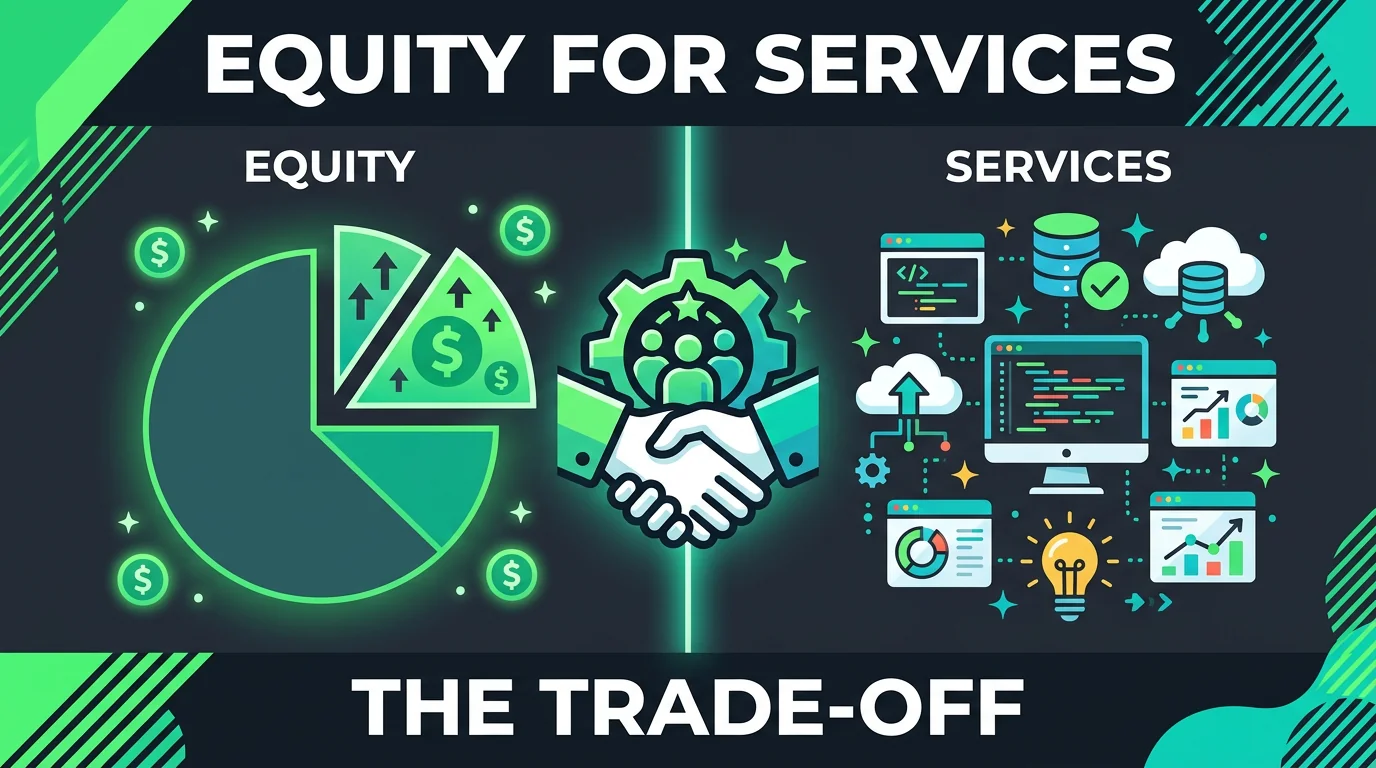
category: “Strategy” tags: [“equity”, “partnerships”, “pre-seed”, “startups”] author: “Jason Overmier” featuredImage: “/images/articles/equity-services-partnerships.webp” imagePrompt: “A dramatic split comparison. Left side shows equity pie chart with slice being traded, green dollar signs. Right side shows development tools and services. A handshake or Partnership symbol in center. Bold white text at top reads ‘Equity for Services’. Bold white text at bottom reads ‘The trade-off’. Dark charcoal background with green and teal accents. High contrast flat design. Partnership value visual.” articleType: “guide” relatedServices: [“mvp-build”, “web-application-development”]
Cash-strapped startups often ask if we’ll work for equity. The question makes sense: you have a compelling vision but limited runway. Trading ownership for development seems like a smart way to extend your resources.