Fixed Price vs Hourly Development: What's Best for Your Project?
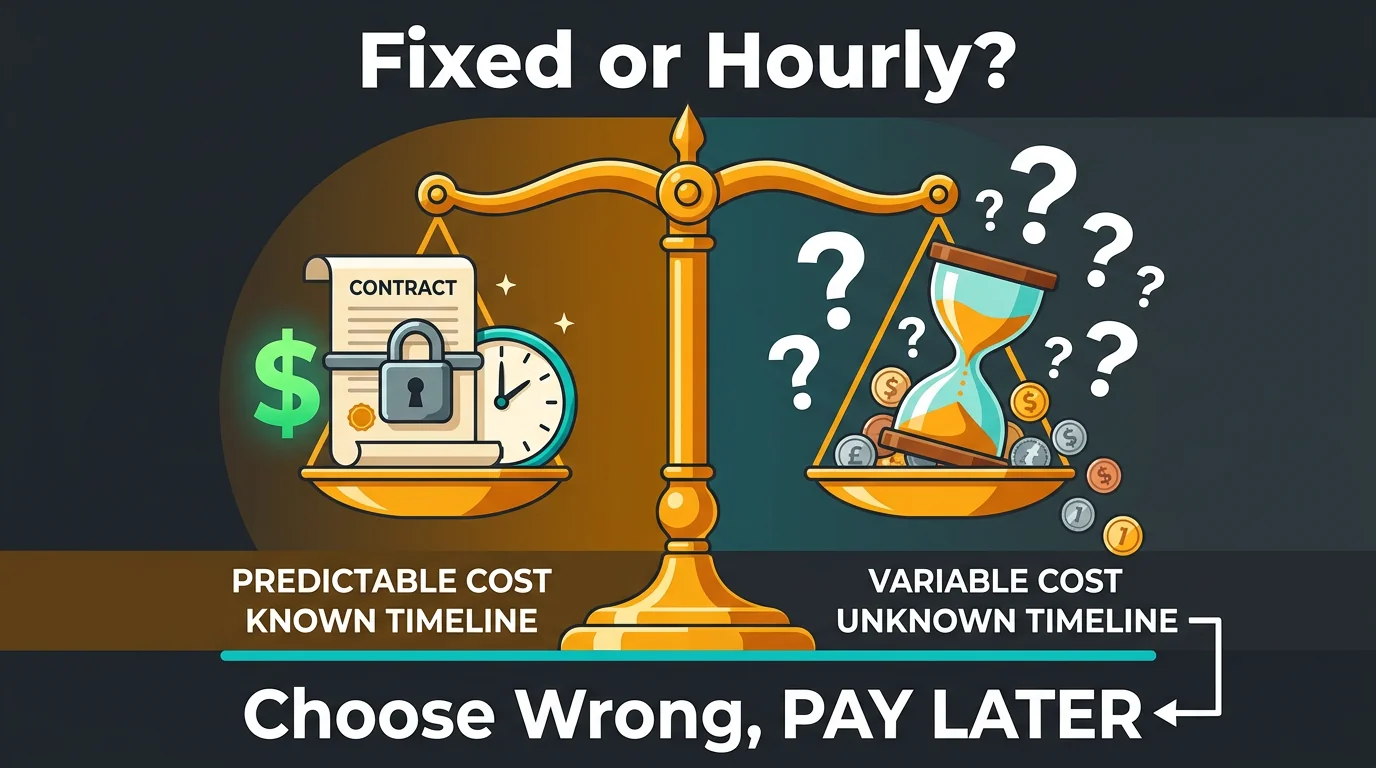
Choosing between fixed-price and hourly billing affects your budget, timeline, and project outcome. Here's how to decide which model fits your situation.
Jason Overmier
Innovative Prospects Team
You’ve found a development partner. The tech stack is decided. Now comes the uncomfortable conversation: how do you pay for it?
The billing model you choose affects more than your budget. It shapes incentives, defines risk allocation, and determines what happens when (not if) requirements change.
Both fixed-price and hourly models work. Both also fail spectacularly when applied to the wrong situation. Here’s how to choose.
Quick Answer
| Your Situation | Recommended Model | Why |
|---|---|---|
| Well-defined MVP | Fixed price | Scope is clear, timeline matters, budget is fixed |
| Exploratory product | Hourly | Requirements will evolve, flexibility is valuable |
| Compliance/regulatory project | Fixed price | Scope is dictated by regulations, less room for change |
| Early-stage startup | Hourly | You’re still learning what to build |
| Tight deadline, firm launch date | Fixed price | Incentivizes on-time delivery |
| Complex integration work | Hourly | Unknown unknowns will surface |
If you’re still unsure after that table, the detailed breakdown below will help.
How Fixed-Price Projects Work
Fixed-price contracts specify a total cost upfront based on agreed-upon scope. You pay X dollars for Y deliverable by Z date.
What’s Typically Included
| Component | Fixed-Price Standard |
|---|---|
| Scope definition | Detailed requirements document before signing |
| Timeline | Firm delivery date with milestones |
| Change requests | Formal process, additional cost for scope changes |
| Payment structure | 25-50% upfront, remainder tied to milestones |
| Risk allocation | Developer absorbs cost overruns (within scope) |
When Fixed Price Works Well
1. Requirements are stable and detailed
You know exactly what you want. Features are specified, user flows are mapped, and the technical approach is clear. Changes will be minimal.
Example: A healthcare startup needs a HIPAA-compliant patient portal. The features are defined by regulatory requirements. There’s little room for “we’ll figure it out as we go.”
2. Budget cannot exceed a specific amount
You raised $50K for product development. Spending $75K isn’t an option. Fixed price guarantees you won’t exceed your budget (assuming scope stays constant).
3. Timeline is business-critical
The product must launch before a conference, regulatory deadline, or funding milestone. Fixed-price contracts create stronger incentives for on-time delivery because delays hurt the developer’s margin.
4. You’re working with an established team
The development partner has built similar projects before. They can accurately estimate effort because they’ve done it dozens of times.
Fixed-Price Red Flags
| Warning Sign | What It Means |
|---|---|
| Price seems too low | Developer will cut corners or fight every change request |
| Vague scope document | You’ll pay for “scope changes” that should have been included |
| No change process defined | Expect conflict when requirements evolve |
| Developer won’t show similar past work | They can’t estimate accurately |
How Hourly Billing Works
Hourly (time-and-materials) contracts charge for actual time spent. You pay for hours worked, regardless of what gets delivered.
What’s Typically Included
| Component | Hourly Standard |
|---|---|
| Scope definition | Flexible, evolves as project progresses |
| Timeline | Estimates provided, but not guaranteed |
| Change requests | Informal, absorbed into ongoing work |
| Payment structure | Weekly or bi-weekly based on hours logged |
| Risk allocation | Client absorbs cost overruns |
When Hourly Works Well
1. Requirements will evolve
You’re building something new and don’t know exactly what you need yet. User feedback will shape the product. Pivots are expected.
Example: A startup is testing a new B2B SaaS concept. They have hypotheses about features, but customer discovery will change priorities. Locking in scope now would waste money building the wrong thing.
2. The problem domain is complex or unfamiliar
Integration with legacy systems, emerging technologies, or novel technical challenges make estimation difficult. Hourly billing reflects the honest reality: no one knows how long it will take.
3. You want maximum flexibility
Speed matters more than cost certainty. You’d rather pay more to change direction quickly than be locked into a fixed scope that no longer makes sense.
4. Trust is high, documentation is low
You’re working with a team you’ve used before. They understand your business. Formal scope documents feel like overhead.
Hourly Billing Red Flags
| Warning Sign | What It Means |
|---|---|
| No time estimates at all | Developer has no idea what they’re doing |
| No weekly hour caps | Costs can spiral without warning |
| No progress reporting | You won’t know you’re over budget until the invoice arrives |
| Developer resists defining milestones | Accountability is low |
Risk Allocation: Who Eats the Cost?
The fundamental difference between models is risk allocation. Understanding this prevents unpleasant surprises.
Fixed-Price Risk Distribution
| Risk | Who Bears It |
|---|---|
| Scope is harder than expected | Developer |
| Developer underestimates time | Developer |
| Requirements change | Client (via change orders) |
| Developer disappears | Client (mitigated by milestone payments) |
Hourly Risk Distribution
| Risk | Who Bears It |
|---|---|
| Scope is harder than expected | Client |
| Developer underestimates time | Client |
| Requirements change | Neutral (absorbed in hourly rate) |
| Developer works slowly | Client (mitigated by time tracking) |
Key insight: Fixed price protects your budget but reduces your flexibility. Hourly protects your flexibility but exposes your budget.
The Hidden Costs of Each Model
Neither model is purely advantageous. Each carries hidden costs that don’t appear in the contract.
Fixed-Price Hidden Costs
| Cost | Why It Happens |
|---|---|
| Lengthier upfront planning | Scope must be exhaustively defined before work begins |
| Change order friction | Every change requires negotiation, approval, potentially extra payment |
| Adversarial relationship | Developer is incentivized to do minimum scope; you’re incentivized to expand it |
| Quality shortcuts | When developer underestimated effort, quality often suffers to preserve margin |
Hourly Hidden Costs
| Cost | Why It Happens |
|---|---|
| Budget uncertainty | Final cost is unknown until project completes |
| Less urgency | Developer is paid regardless of timeline |
| Requires active management | You must monitor hours, velocity, and progress |
| Scope creep | Without fixed boundaries, features multiply |
Hybrid Approaches
Many projects benefit from hybrid models that combine elements of both.
Common Hybrids
| Model | How It Works | Best For |
|---|---|---|
| Fixed-price phases | Each phase is fixed-price, overall project is flexible | Large projects with natural breakpoints |
| Hourly with cap | Hourly billing up to a maximum budget | Projects with some uncertainty but limited budget |
| Fixed-price core + hourly enhancements | MVP is fixed, improvements are hourly | Products that need to launch but will evolve |
Our MVP projects typically use fixed-price for the core deliverable (we know what an MVP takes) with hourly for post-launch iterations (we don’t know what users will want yet).
Common Pitfalls
| Pitfall | Why It Happens | Fix |
|---|---|---|
| Choosing fixed-price for exploratory work | Wanting budget certainty for uncertain work | Use hourly until scope crystallizes, then consider fixed |
| No change order process in fixed-price | Assuming changes won’t happen | Define change process before signing |
| Hourly without time tracking visibility | Trusting without verifying | Require access to time logs, weekly summaries |
| Picking based on lowest cost | Budget pressure | Pick based on which model fits your situation |
| Not defining “done” | Vague acceptance criteria | Specify exactly what delivery looks like |
Decision Framework
Answer these questions to choose your model:
-
Can you write a detailed requirements document today?
- Yes → Fixed price is viable
- No → Hourly is safer
-
Will requirements likely change significantly during development?
- No → Fixed price reduces your risk
- Yes → Hourly gives you flexibility
-
Is staying under a specific budget more important than feature completeness?
- Yes → Fixed price with prioritized scope
- No → Hourly with continuous prioritization
-
Does the launch date have external consequences?
- Yes → Fixed price with timeline guarantees
- No → Hourly with milestone targets
-
Have you worked with this developer before?
- Yes → Either can work
- No → Fixed price provides more protection
Our Approach
We offer both models because different projects need different approaches.
Fixed-price MVPs: When you know what you need, we give you a fixed cost and timeline. Our 8-week MVP sprints are fixed-price because we’ve built enough MVPs to estimate accurately.
Hourly for evolving products: When you’re still discovering product-market fit, hourly gives you the flexibility to pivot without renegotiating contracts.
The model should serve your project, not the other way around.
Choosing the right billing model is just one part of finding the right development partner. If you’re evaluating options for your next project, book a free consultation. We’ll discuss your specific situation and recommend the approach that fits, even if it’s not with us.