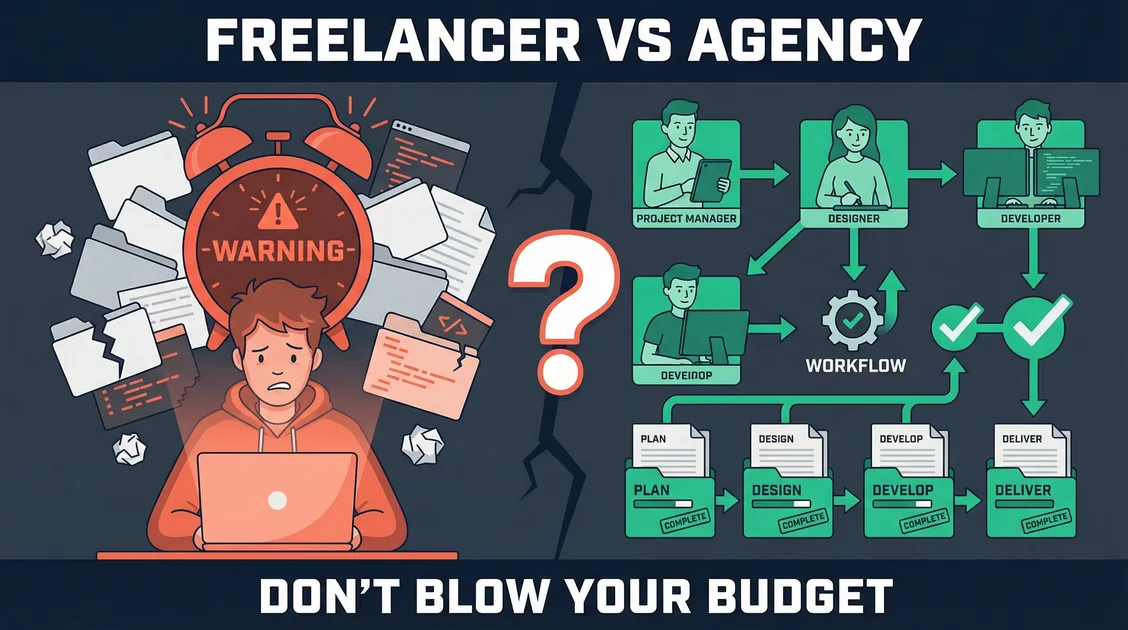
Freelance Developer vs Agency: What's Right for Your MVP?
Choosing between a freelance developer and an agency for your MVP? Here's a practical framework based on budget, timeline, and risk tolerance.
Jason Overmier
Innovative Prospects Team
Freelance Developer vs Agency: What’s Right for Your MVP?
You’ve validated your concept, raised some capital (or allocated budget), and you’re ready to build your MVP. Now you face a critical decision: hire a freelance developer or work with an agency?
Both options can deliver a working product, but the right choice depends on your budget, timeline, risk tolerance, and long-term vision. Choose poorly and you could waste months and tens of thousands of dollars.
Quick Answer
For most seed-stage MVPs with $25K-$100K budgets, a specialized agency is the better choice because you get a full team, predictable timelines, and reduced technical risk. However, if you have extremely limited budget ($10K-$25K) or need ongoing part-time development, a freelancer may be more appropriate—assuming you accept the higher risks.
The decision ultimately comes down to risk tolerance. Freelancers offer lower cost but higher single-point-of-failure risk. Agencies cost more but distribute risk across a team with established processes.
Comparison Table
| Factor | Freelance Developer | Agency | Winner |
|---|---|---|---|
| Cost | $75-$150/hour or $10K-$40K per MVP | $125-$250/hour or $25K-$100K per MVP | Freelancer (if budget constrained) |
| Timeline | Variable (depends on availability) | Predictable (dedicated resources) | Agency |
| Team Breadth | One person (generalist or specialist) | Full team (design, dev, QA, PM) | Agency |
| Risk | High (single point of failure) | Low (distributed across team) | Agency |
| Communication | Direct to developer | Through PM/account manager | Tie (depends on preference) |
| Scalability | Limited (one person’s capacity) | High (can add resources) | Agency |
| Code Quality | Variable (individual standards) | Consistent (team standards + review) | Agency |
| Long-term Support | Uncertain (freelancer may leave) | Stable (agency continues) | Agency |
Overall: Agency wins for most MVP situations due to reduced risk and predictable delivery. Freelancer wins only for extremely budget-constrained or very simple projects.
When to Choose a Freelance Developer
A freelance developer excels in these scenarios:
Best For
- Budgets under $25K - You can’t afford agency rates and need to stretch every dollar
- Simple, focused products - Single-purpose apps with straightforward requirements
- Ongoing part-time needs - You need 10-20 hours/week consistently, not a full sprint
- Technical founder partnerships - You’re technical yourself and need an extra pair of hands
- Specific expertise gaps - You need a narrow specialist (e.g., “React Native expert”) for a short period
Key Advantages
| Advantage | Why It Matters |
|---|---|
| Lower cost | More budget for other areas like marketing |
| Direct communication | No account manager filtering information |
| Flexibility | Can scale hours up or down as needed |
| Specialized expertise | Can hire exactly the specialist you need |
Trade-offs to Consider
- Single point of failure - If your freelancer gets sick, takes another job, or ghosts you, your project stops
- Limited bandwidth - One person can only do so much; complex features take longer
- Skill gaps - Your freelancer may be a great React developer but struggle with database design or DevOps
- Inconsistent availability - Good freelancers juggle multiple clients; you’re not their only priority
- No redundancy - Knowledge lives in one person’s head; if they leave, you’re starting over
Real-World Example
A solo founder with $20K budget hired a freelance React developer to build a simple CRUD app. The freelancer worked nights and weekends, keeping costs low. The product launched in 4 months, but the founder had to handle all product decisions, UI design, and database choices themselves. It worked—but only because the founder was willing to be deeply involved in every technical decision.
When to Choose an Agency
An agency is the better choice when:
Best For
- Budgets $25K-$100K+ - You have sufficient budget for a full team approach
- Complex products - Multiple integrations, custom backends, non-standard features
- Timeline certainty - You need to launch by a specific date (funding runway, market window)
- Limited technical expertise - You’re a non-technical founder who needs guidance
- Long-term partnership - You want a team that can scale from MVP to production-grade
Key Advantages
| Advantage | Why It Matters |
|---|---|
| Full team access - Design, frontend, backend, QA, project management | You get specialists for each area, not a generalist |
| Predictable delivery - Established processes and timelines | You can plan your business around launch dates |
| Reduced risk - Team continuity if someone leaves | Your project doesn’t depend on one person |
| Code quality standards - Peer review, testing, documentation | More maintainable code, easier to hand off |
| Scalability - Can add resources as needed | Speed up when you need to hit milestones |
Trade-offs to Consider
- Higher cost - You’re paying for team overhead and project management
- Less direct access - Communication flows through a project manager
- Potential for scope creep - Agencies may upsell features you don’t need
- Contract complexity - Longer contracts, more formal processes
Real-World Example
A funded startup with $75K budget hired an agency to build their MVP. The agency provided a product manager, designer, frontend developer, backend developer, and QA. The MVP launched in 8 weeks with all core features. When the startup raised their Series A, the same agency scaled the team to 5 developers and added a DevOps engineer for the production build.
Common Pitfalls
| Pitfall | Why It Happens | How to Avoid |
|---|---|---|
| Hiring the wrong freelancer expertise | Choosing a generalist when you need a specialist | clearly define technical requirements, review specialized experience |
| Freelancer ghosting | No contract, no milestones, upfront payment | Use milestone-based payments, clear deliverables, legal contract |
| Agency scope creep | Agency sells more than you need | Define fixed scope, get detailed breakdown, resist “nice-to-have” upsells |
| Communication breakdown with freelancer | Assuming they know what you want | Weekly syncs, written requirements, screenshare reviews |
| Agency over-engineering | Building enterprise-grade for an MVP | Insist on MVP simplicity, question every feature |
| Freelancer knowledge silo | Only they understand the code | Require documentation, regular code reviews, commented code |
| Agency under-delivering | Not getting enough attention | Clarify team allocation, request daily/weekly updates |
Our Recommendation Framework
Use this decision tree to determine the right approach:
Start by asking:
-
What’s your budget?
- Under $25K → Lean toward freelancer (or consider no-code)
- $25K-$100K → Agency is viable and recommended
- $100K+ → Agency for speed and certainty
-
How complex is your MVP?
- Simple CRUD app, few integrations → Freelancer can handle it
- Multiple integrations, custom logic, realtime features → Agency for team breadth
- Unsure? → Assume more complex than you think
-
What’s your risk tolerance?
- High tolerance (can afford delays, rework) → Freelancer
- Low tolerance (need to hit specific dates) → Agency for predictability
-
Are you technical?
- Yes → Freelancer becomes more viable (you can guide and review)
- No → Agency provides the technical leadership you lack
-
Do you need to scale quickly post-launch?
- Yes → Agency can seamlessly add resources
- No → Freelancer may be sufficient initially
Still unsure? Consider these factors:
- Timeline sensitivity: If you need to launch before funding runs out or for a specific market opportunity, an agency’s predictability is worth the premium.
- Long-term vision: If you plan to raise a round and scale significantly, starting with an agency that can grow with you saves the transition cost later.
- Your involvement level: Freelancers require more hands-on management. Agencies require strategic oversight but less day-to-day technical management.
The Hybrid Approach: When to Combine Both
Some situations call for a mixed strategy:
Freelancer + Agency:
- Use an agency for core development (backend, infrastructure, complex features)
- Use a freelancer for specialized needs (mobile app, specific integration, data migration)
Fractional CTO + Freelance Team:
- Hire a fractional CTO (technical advisor) to architect and oversee
- Use freelancers for implementation at their direction
- Cost: Middle ground between pure freelancer and pure agency
Example: A startup hired a fractional CTO ($5K/month) to design the architecture and manage two freelancers ($100/hour each). Total monthly cost of ~$21K provided technical leadership plus implementation flexibility.
Red Flags: When to Walk Away
Freelancer Red Flags:
- Unwilling to sign a contract or define milestones
- Can’t show live examples of their work
- Promises unrealistically fast delivery
- Poor communication during hiring process
- No references from past clients
Agency Red Flags:
- Won’t specify who will be working on your project
- Vague scope without detailed breakdown
- Pressure to sign long-term contracts immediately
- No experience in your industry or with similar projects
- Guarantees that sound too good to be true
How We Can Help
We help founders navigate decisions like this every day. As a US-based, senior-led agency, we offer the best of both worlds: predictable delivery, full-team expertise, and transparent communication.
Our MVP Build service delivers in 8 weeks with a fixed price, clear timeline, and team that’s built your type of product before.
Book a free consultation to discuss your specific situation.
Unsure which path is right for you? Let’s talk through your specific requirements, budget, and timeline.