GDPR Compliance for US-Based SaaS: What You Need to Know
Your SaaS has EU customers, which means GDPR applies to you. Here's what US-based companies need to understand about compliance without over-engineering.
Jason Overmier
Innovative Prospects Team
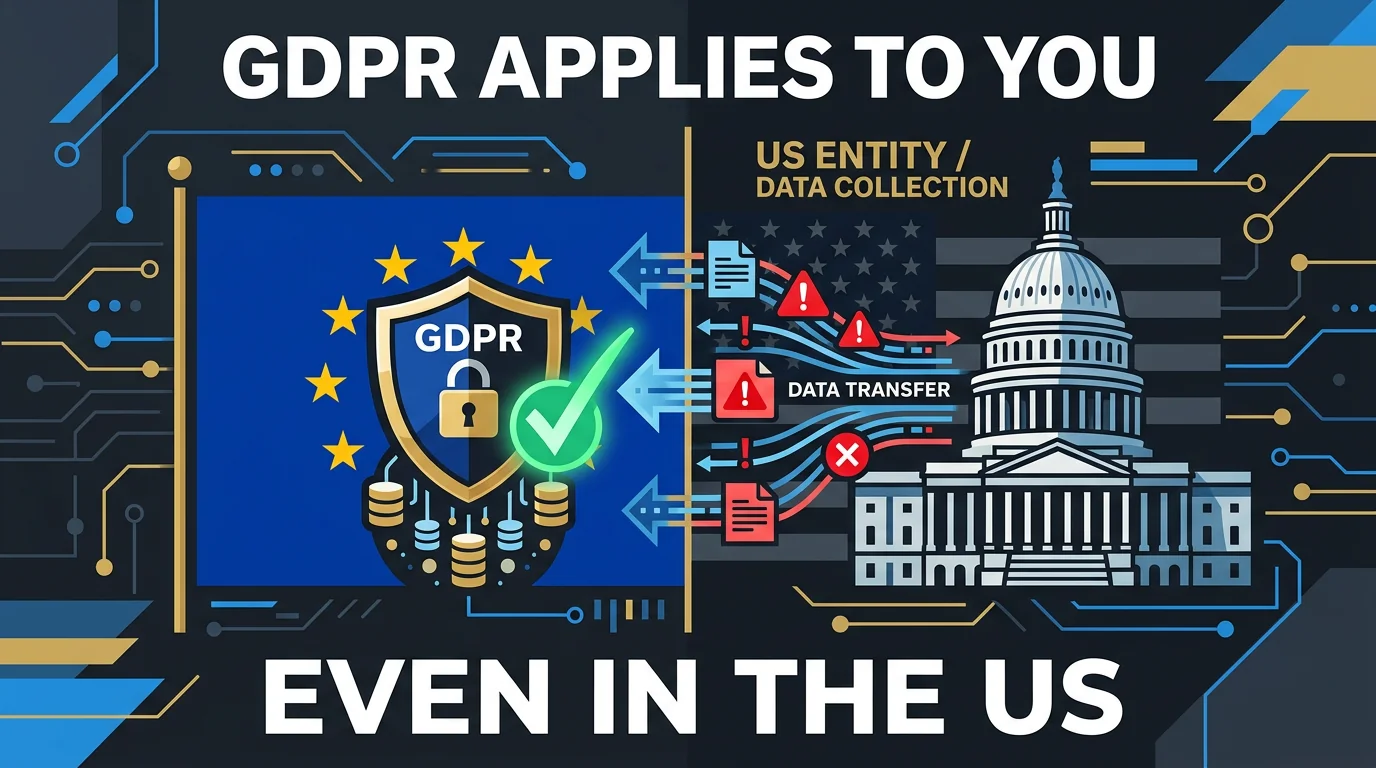
If your SaaS has a single EU customer, GDPR applies to you. It doesn’t matter that your company is in the US. It doesn’t matter that your servers are in Virginia. EU data protection law follows EU citizens’ data wherever it goes.
Many US companies discovered this the hard way when Austrian and German regulators started enforcing GDPR against American businesses. The fines can reach 4% of global annual revenue.
Here’s what US-based SaaS companies need to understand about GDPR compliance.
Quick Answer
| Question | Answer |
|---|---|
| Does GDPR apply to US companies? | Yes, if you have EU customers or track EU visitors |
| What’s the maximum fine? | €20 million or 4% of global annual revenue, whichever is higher |
| Do I need a DPO? | Only if you process data at scale or handle sensitive categories |
| Do I need EU representation? | Yes, if you don’t have an EU presence |
| Can I store data in the US? | Only with proper safeguards (Standard Contractual Clauses or adequacy decision) |
Who GDPR Applies To
GDPR applies to any organization that:
- Offers goods or services to EU residents (even if free)
- Monitors behavior of EU residents (tracking, analytics, profiling)
You don’t need an EU office. You don’t need EU employees. A single EU customer triggers the regulation.
Examples
| Scenario | GDPR Applies? |
|---|---|
| US SaaS with one paying customer in Germany | Yes |
| US blog with EU visitors, using Google Analytics | Yes (monitoring) |
| US e-commerce that ships to EU | Yes |
| US company with no EU customers and geo-blocking | No |
| US company with EU customers but all processing in EU | Yes (but easier compliance) |
Core Requirements
GDPR has 99 articles, but most of what you need to know fits into these categories:
1. Lawful Basis
You need a legal basis to process personal data. The most common for SaaS:
| Basis | When to Use |
|---|---|
| Contract | Processing necessary to provide your service |
| Consent | Marketing emails, cookies, optional features |
| Legitimate Interest | Fraud prevention, security (with balancing test) |
For most SaaS: Contract basis for core service, consent for marketing and optional features.
2. Data Subject Rights
EU residents have rights you must honor:
| Right | What It Means | Your Obligation |
|---|---|---|
| Access | Know what data you hold | Provide data export on request |
| Rectification | Correct inaccurate data | Allow updates, correct on request |
| Erasure | Delete their data | Delete within 30 days (with exceptions) |
| Portability | Get data in machine-readable format | Provide structured export |
| Objection | Stop certain processing | Honor opt-outs |
| Restriction | Limit processing | Freeze data during disputes |
Practical requirement: Build workflows to respond to these requests within 30 days.
3. Data Protection Principles
| Principle | Practical Meaning |
|---|---|
| Purpose limitation | Only use data for stated purposes |
| Data minimization | Collect only what you need |
| Accuracy | Keep data current |
| Storage limitation | Delete when no longer needed |
| Security | Appropriate protection measures |
| Accountability | Document your compliance |
4. International Data Transfers
Transferring EU data to the US requires safeguards. Options:
| Mechanism | Status |
|---|---|
| EU-US Data Privacy Framework | Available for certified US companies (2023+) |
| Standard Contractual Clauses (SCCs) | Valid but requires transfer impact assessment |
| Binding Corporate Rules | For intra-company transfers (complex) |
| Derogations | Specific consent or contract necessity (limited) |
For most US SaaS: Either certify under the EU-US Data Privacy Framework or implement SCCs.
Technical Requirements
Data Mapping
You must know what personal data you collect, where it’s stored, and who accesses it.
Document:
| Item | Examples |
|---|---|
| Data categories | Name, email, IP address, usage data |
| Data sources | User input, cookies, third parties |
| Storage locations | Database, S3, SaaS tools |
| Access controls | Who can see what |
| Retention periods | How long you keep each type |
Security Measures
GDPR requires “appropriate” security. For a SaaS, this typically means:
| Category | Requirements |
|---|---|
| Access control | Role-based access, strong authentication |
| Encryption | At rest and in transit |
| Logging | Audit trails for data access |
| Incident response | Plan for breaches |
| Vendor management | DPAs with all processors |
Breach Notification
If you have a data breach affecting EU residents:
| Requirement | Timeline |
|---|---|
| Notify supervisory authority | Within 72 hours of becoming aware |
| Notify affected individuals | ”Without undue delay” if high risk |
| Document the breach | Keep records for accountability |
Practical requirement: Have an incident response plan that can execute within 72 hours.
Documentation Requirements
GDPR requires you to demonstrate compliance. Key documents:
| Document | Purpose |
|---|---|
| Privacy policy | Inform data subjects about processing |
| Records of processing activities | Internal documentation of all processing |
| Data Protection Impact Assessment | Required for high-risk processing |
| Standard Contractual Clauses | For US-EU data transfers |
| Data Processing Agreements | With all vendors who touch personal data |
Privacy Policy Requirements
Your privacy policy must include:
- Identity of the controller (your company)
- Contact details for data protection officer (if applicable)
- Purposes of processing and legal basis
- Categories of recipients (who you share with)
- International transfer details and safeguards
- Retention periods
- Data subject rights
- Right to lodge complaints with supervisory authority
- Whether data provision is required for the service
Common Mistakes
| Mistake | Why It’s a Problem | Fix |
|---|---|---|
| Ignoring GDPR | Fines apply regardless of knowledge | Accept that it applies and comply |
| Treating consent as the only basis | Consent can be withdrawn, creating chaos | Use contract basis for core service |
| Not updating privacy policy | Must reflect actual practices | Review and update when practices change |
| No data processing agreements | You’re liable for vendor violations | Execute DPAs with all data processors |
| Storing data forever | Violates storage limitation | Define and enforce retention policies |
| No response workflow for rights | Must respond within 30 days | Build the workflow before you need it |
Implementation Checklist
Phase 1: Foundation
- Document all personal data you collect
- Map where data is stored and who accesses it
- Update privacy policy to meet GDPR requirements
- Identify lawful basis for each processing activity
- Register with EU-US Data Privacy Framework (if eligible)
Phase 2: Rights and Processes
- Create workflow for data access requests
- Create workflow for data deletion requests
- Create workflow for data portability requests
- Set up consent management for marketing
- Define retention periods for each data category
Phase 3: Technical Controls
- Implement encryption at rest and in transit
- Review and strengthen access controls
- Set up audit logging for sensitive data access
- Create incident response plan
- Execute DPAs with all data processors
Phase 4: Ongoing
- Train team on GDPR requirements
- Schedule regular compliance reviews
- Monitor for regulatory changes
- Update documentation when practices change
The US State Privacy Law Overlap
While focusing on GDPR, don’t ignore US state laws that impose similar requirements:
| State | Key Requirements |
|---|---|
| California (CCPA/CPRA) | Right to delete, opt-out of sale, data access |
| Virginia (VCDPA) | Similar to CCPA with some differences |
| Colorado (CPA) | Data minimization, purpose specification |
| Connecticut, Utah, etc. | Various requirements emerging |
Good news: GDPR compliance often covers most US state requirements. Build for GDPR, then adjust for state-specific provisions.
When to Get Help
| Situation | Recommendation |
|---|---|
| Basic SaaS with standard data | Self-implement with templates |
| Processing sensitive data | Consult a privacy lawyer |
| Large-scale processing | Consider a Data Protection Officer |
| Received a complaint or inquiry | Legal counsel immediately |
| Cross-border complexity | Specialized privacy counsel |
GDPR compliance isn’t a one-time project. It’s an ongoing program that requires documentation, processes, and technical controls. If you’re building a SaaS that will serve EU customers and want guidance on privacy-by-design architecture, book a consultation. We’ll help you build compliance into your product from the start.