The Hidden Costs of 'Cheap' Overseas Development
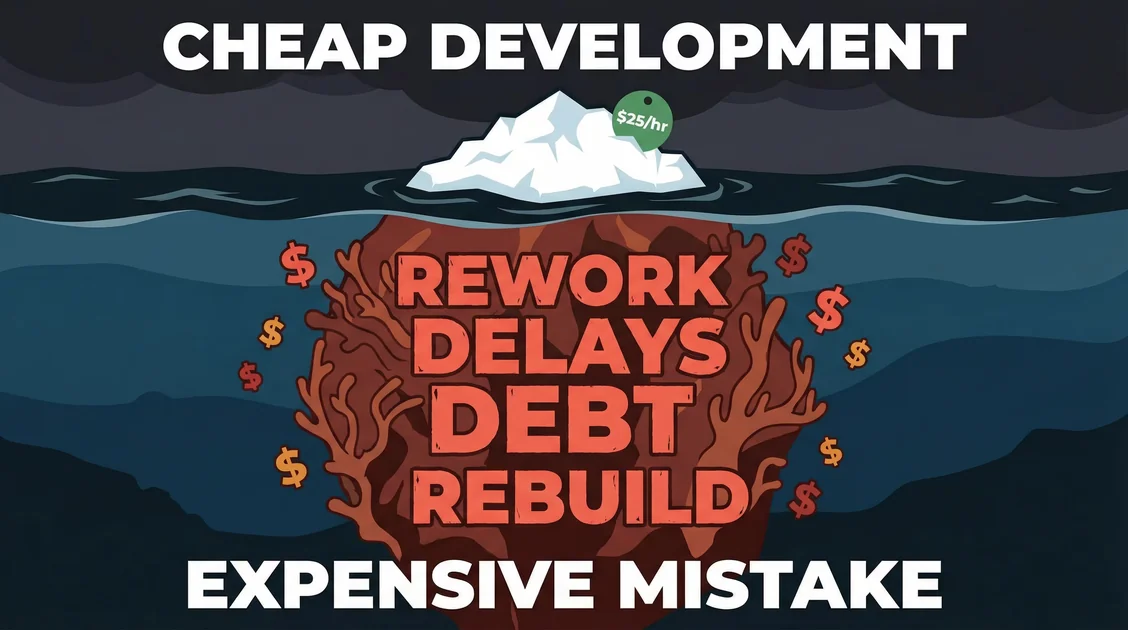
Overseas development seems like a smart way to stretch your budget. But the hidden costs of communication gaps, rework, and technical debt often make cheap development expensive in the long run.
Jason Overmier
Innovative Prospects Team
The Hidden Costs of “Cheap” Overseas Development
You’ve seen the ads. “$25/hour developers,” “Full-stack team for $3K/month,” “Why pay US rates?” It’s tempting, especially when you’re running a startup on a tight budget.
But here’s what those ads don’t tell you: the lowest hourly rate often produces the highest total cost.
We’ve spent years cleaning up projects built by overseas teams. The stories are remarkably similar: what started as a cost-saving measure ended in blown timelines, frustrated founders, and expensive rework.
The Illusion of Savings
On paper, the math looks compelling:
| Option | Hourly Rate | Hours for MVP | Total Cost |
|---|---|---|---|
| Overseas team | $25/hour | 1,000 hours | $25,000 |
| US agency | $150/hour | 400 hours | $60,000 |
Looks like a $35K savings, right? But the math is wrong because it assumes equal productivity and quality.
The real comparison looks more like this:
| Factor | Overseas Team | US Agency |
|---|---|---|
| Hourly rate | $25 | $150 |
| Actual hours needed | 1,500-2,000 (rework, communication) | 400-500 |
| Rework percentage | 30-50% | 5-10% |
| Timeline | 6-9 months | 2-3 months |
| True cost | $37,500-$50,000 | $60,000-$75,000 |
The savings aren’t what they seemed, and that’s before you count the opportunity cost of launching 3-4 months later.
The Communication Tax
Time zones and language barriers create real friction. Every unclear requirement, every misunderstood feature, every misaligned expectation costs time.
What we see repeatedly:
- Requirements documents are read literally, not critically
- Cultural assumptions differ (UX patterns, business logic, edge cases)
- Questions go unasked to avoid appearing incompetent
- Progress is reported optimistically until deadlines are missed
Example: A founder hired an overseas team to build a fintech app. The team delivered exactly what was specified, but the requirements didn’t account for edge cases in transaction reconciliation. The “finished” product couldn’t handle refunds, partial payments, or chargebacks. Six months and $30K later, the app finally worked.
A US-based senior developer would have asked: “What happens when a transaction fails mid-stream?” The overseas team followed the spec without questioning it.
The communication tax: 2-3x more time spent clarifying, reviewing, and reworking.
The Seniority Gap
There’s a reason rates differ: senior US developers earn $150-$250/hour because they deliver 3-5x the value of a junior developer.
Overseas outsourcing reality:
- You’re rarely getting senior engineers at bargain rates
- Senior engineers overseas charge near-US rates for international clients
- The “cheap” developers are often junior or inexperienced
- High turnover means your project trains new developers repeatedly
What senior developers do automatically:
- Question requirements that don’t make sense
- Anticipate edge cases and scalability issues
- Recommend better approaches based on experience
- Mentor others and establish best practices
- Make architectural decisions that prevent future rework
What you get with cheap offshore:
- Literal implementation of specifications
- Questions answered but not anticipated
- Problems discovered in production, not prevented
- Technical debt that accumulates silently
The seniority tax: 50-100% more work fixing issues a senior would have prevented.
The Time Zone Penalty
Twelve-hour time differences sound manageable, until you’re living them.
The reality of distributed teams:
- One round trip for a simple question: 24 hours
- Urgent decisions wait until the next business day
- Iteration cycles stretch from hours to days
- Real-time collaboration (pairing, whiteboarding) is impossible
The compounding effect:
- One unclear requirement = 1 day delay
- Five unclear requirements per week = 1 week lost per month
- Three-month project becomes five-month project
- Your launch window closes, competitors move ahead
The timezone tax: 50-100% longer timelines due to communication latency.
The Hidden Cost of Rework
This is where cheap development becomes truly expensive.
Common patterns we see:
- Wrong architecture for the use case - Works for demo, breaks at scale
- Security vulnerabilities - No input sanitization, exposed API keys, weak authentication
- Poor database design - No indexes, wrong data types, no migration strategy
- Hard-coded values - Configuration baked into code, no environment separation
- No testing - Unit tests, integration tests, end-to-end tests don’t exist
- Poor error handling - Errors swallowed, users see blank screens, no logging
Fixing these issues costs 3-5x the original build.
Real example: A startup spent $20K on overseas development for an MVP. Six months later, they paid us $75K to rebuild it properly because the original code couldn’t scale, had security issues, and was unmaintainable.
Total spent: $95K. The “cheap” option was the most expensive path.
The Technical Debt Multiplier
Every shortcut taken to ship faster becomes debt that accumulates interest.
Technical debt from cheap development:
- Copy-pasted code instead of reusable components
- Database queries that don’t scale (N+1 problems, missing indexes)
- No state management: props drilling everywhere
- No documentation: future developers (or you) can’t understand the code
- No error boundaries: one component crash breaks the entire app
- No monitoring: you don’t know what’s broken until customers complain
The debt service:
Every future feature takes longer because you’re working around fragile foundations instead of building on solid ones.
The Opportunity Cost: Launching Late
While you’re dealing with rework and communication gaps, the market moves on.
What you lose:
- First-mover advantage
- Early customer feedback
- Revenue from delayed launch
- Investor confidence when milestones are missed
- Team morale from constant setbacks
The math: Launching 3 months late in a fast-moving market can mean missing the window entirely. Your “savings” cost you the company.
The Intellectual Property Risk
This doesn’t get discussed enough, but it’s real.
Risks with overseas development:
- Legal jurisdiction makes IP enforcement difficult or impossible
- Code may be reused for other clients (you’d never know)
- Source code may not be deliverable if disputes arise
- No non-compete enforcement in many jurisdictions
US-based advantage:
- Clear legal frameworks
- Enforceable contracts
- Established IP protections
- Accountability and reputation mechanisms
When your code is your product, IP protection matters.
When Overseas Development Makes Sense
We’re not saying all overseas development is bad. Here are situations where it works:
You have a technical co-founder managing the work
- They can review code, guide decisions, catch issues early
- The offshore team extends capacity, not replaces technical leadership
Well-defined, non-critical projects
- Internal tools where bugs aren’t catastrophic
- Proof-of-concept where quality matters less than speed
- Isolated features with clear specifications
You’ve established a relationship with a trusted team
- Not hiring from a marketplace sight-unseen
- Ongoing relationship where they understand your business
- You’ve paid for their learning curve already
What we’re warning against:
- Non-technical founders hiring overseas teams for core product development
- Critical business software built by the lowest bidder
- Complex products managed without technical oversight
The US Agency Alternative
We know agencies cost more. Here’s what you get for the premium:
| What You Pay For | Why It Matters |
|---|---|
| Senior developers | 3-5x productivity, architectural thinking, issue prevention |
| Same-timezone communication | Real-time collaboration, fast iteration, quick decisions |
| Established processes | Code review, testing, documentation, deployment automation |
| Accountability | Legal recourse, reputation at stake, business relationship |
| Full team access | Design, backend, frontend, QA, not just one developer |
| IP ownership clarity | Clean contracts, US legal jurisdiction, deliverables guaranteed |
The ROI:
- Launch 2-3x faster
- 80-90% less rework
- Code you can maintain and scale
- Peace of mind that lets you focus on business, not bugs
The Decision Framework
Use overseas development if:
- You have a technical co-founder managing the work
- The project is well-defined and non-critical
- You have an established relationship with the team
- You have time to absorb delays and rework
- Budget is truly the primary constraint
Use a US-based agency if:
- You’re building your core product
- You’re non-technical and need technical guidance
- Timeline certainty matters (funding runway, market window)
- Quality and scalability are important
- You want IP protection and legal accountability
Be honest about which describes your situation.
How We’re Different
We’re a US-based, senior-led agency. Every project gets a team with 15+ years of experience, not juniors learning on your dime.
Our MVP Build service delivers in 8 weeks with fixed pricing, clear milestones, and code you can maintain long after we’re gone.
Our clients say the same thing: “I wish I’d started here instead of wasting time and money on cheap development.”
Book a free consultation to discuss your project.
Wondering if cheap development will actually save you money? Let’s talk about your specific situation. We’ll tell you honestly if we’re the right fit or not.