Junior Developer Postings Down 40%: The Career Pathway Collapse
Entry-level development jobs are disappearing as AI handles routine coding tasks. What this means for hiring, team composition, and the future of software careers.
Jason Overmier
Innovative Prospects Team
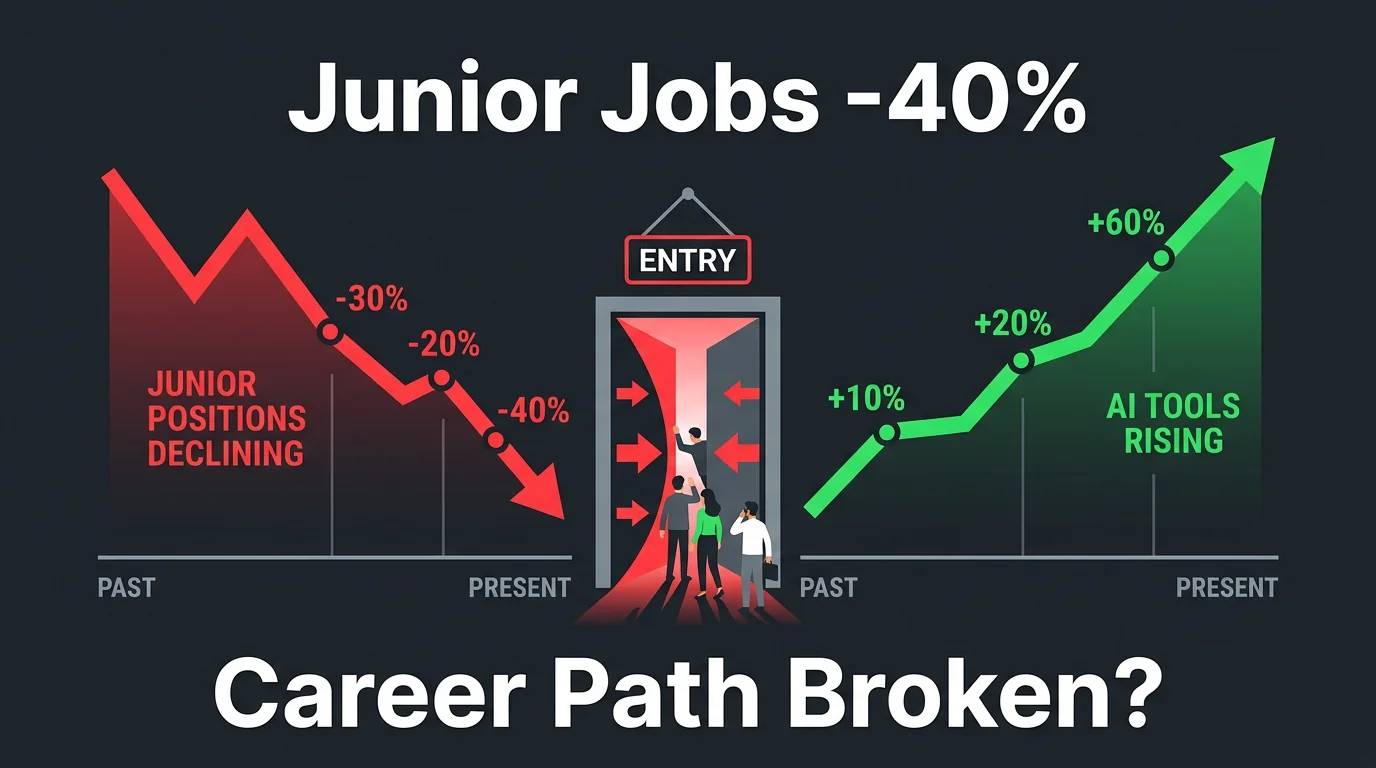
Something quiet but significant is happening in the software job market: junior developer positions have contracted by 40% since 2022. The entry-level roles that launched millions of careers are disappearing.
This isn’t a temporary market correction. It’s a structural shift driven by AI’s ability to handle routine coding tasks that used to be junior developers’ primary work.
The implications extend beyond individual careers. They affect how teams are built, how knowledge transfers, and who will become the senior developers of tomorrow.
The Data
According to job market analysis and hiring data:
| Metric | 2022 | 2024 | Change |
|---|---|---|---|
| Junior developer postings | Baseline | -40% | Significant decline |
| Senior developer postings | Baseline | +15% | Growing demand |
| Junior applications per posting | 100 | 300 | 3x competition |
| Average time to fill junior role | 3 weeks | 6 weeks | More selective hiring |
| Junior salary offers | $75K | $70K | Downward pressure |
The pattern is consistent across job boards, recruiting firms, and company reports.
Why This Is Happening
AI Handles Entry-Level Work
The tasks traditionally assigned to junior developers are exactly what AI handles best:
| Junior Task | AI Capability | Impact |
|---|---|---|
| Writing simple CRUD | Excellent | Less junior work needed |
| Creating basic components | Strong | AI generates from description |
| Writing unit tests | Good | AI scaffolds tests |
| Bug fixing (simple) | Strong | AI finds and fixes common bugs |
| Documentation | Excellent | AI writes docs from code |
When a senior developer can prompt an AI to produce work that used to require a junior, the junior position becomes optional.
The Senior Leverage Effect
One senior with AI tools can produce what used to require a senior plus 2-3 juniors:
| Team Composition | Output | Cost |
|---|---|---|
| Traditional: 1 senior + 3 juniors | 100 units | $425K/year |
| AI-augmented: 2 seniors + AI | 120 units | $450K/year |
The AI-augmented team produces more with similar cost, higher quality, and less management overhead.
Risk Reduction
Juniors require supervision, make mistakes, and take time to become productive. AI makes fewer mistakes in its domain and requires no management:
| Factor | Junior Developer | AI Tool |
|---|---|---|
| Supervision needed | High | Low (verification only) |
| Time to productivity | 6-12 months | Immediate |
| Error types | Learning curve errors | Subtle errors |
| Scalability | Linear (hire more) | Near-infinite |
| Management overhead | Significant | Minimal |
For cost-conscious teams, the calculus has shifted.
The Pipeline Problem
The junior pipeline feeds the mid-level and senior pipeline 5-10 years later. Breaking it has delayed consequences:
| Year | What Happens |
|---|---|
| Now | Fewer juniors hired |
| 3-5 years | Fewer mid-level developers |
| 5-10 years | Fewer seniors, severe shortage |
| 10+ years | New equilibrium with different structure |
Today’s senior developer shortage will compound in 5-10 years when the missing juniors would have become seniors.
Knowledge Transfer Gap
Juniors learn from seniors through code review, pair programming, and gradual responsibility increase. Without juniors:
| Loss | Consequence |
|---|---|
| Pair programming | Less knowledge transfer |
| Code review teaching | Seniors review AI, not juniors |
| Gradual responsibility | No one to delegate to |
| Institutional knowledge | Concentrated in fewer people |
Knowledge becomes concentrated in current seniors with limited pathways to new developers.
What This Means for Teams
Hiring Strategy
If you’re building a team today:
| Approach | Rationale |
|---|---|
| Hire seniors primarily | Immediate productivity, AI leverage |
| Be highly selective with juniors | Only exceptional candidates justify the investment |
| Invest in AI tools | Enables senior leverage |
| Consider non-traditional paths | Bootcamps may produce fewer viable candidates |
| Plan for senior scarcity | Competition for seniors will increase |
Team Structure
The traditional pyramid is inverting:
| Era | Structure | Rationale |
|---|---|---|
| Pre-AI | Many juniors, some mids, few seniors | Juniors handle volume |
| Current | Few juniors, some mids, more seniors | Seniors + AI handle volume |
| Future | Very few juniors, many seniors | AI handles routine work |
Compensation Implications
| Role | Pressure | Why |
|---|---|---|
| Juniors | Downward | Fewer positions, more competition |
| Mid-level | Flat | Transitioning role |
| Seniors | Upward | High demand, limited supply |
What This Means for Career Seekers
The traditional path into software development is narrowing. Alternatives are emerging:
Alternative Entry Points
| Path | What It Involves |
|---|---|
| Open source contributions | Build portfolio through public work |
| Internal transfers | Move from other roles within companies |
| Contract/freelance work | Build experience outside traditional employment |
| Founding/building | Create your own products |
| Specialized domains | Enter through niche expertise |
Skills That Still Matter
AI-proof entry-level skills that employers still value:
| Skill | Why It Matters |
|---|---|
| System design | AI struggles with architecture |
| Problem decomposition | Breaking down ambiguous problems |
| Communication | Translating between business and tech |
| Domain expertise | Industry knowledge AI lacks |
| Debugging complex systems | AI struggles with novel problems |
The Premium on Differentiation
Generic “can code” skills no longer differentiate. Entry-level candidates need:
| Differentiator | Why It Works |
|---|---|
| Shipped products | Proves end-to-end capability |
| Open source track record | Demonstrates collaboration |
| Domain expertise | Adds value beyond coding |
| AI proficiency | Knows how to leverage tools effectively |
| Complex projects | Shows judgment, not just syntax |
Responses from the Industry
Universities and Bootcamps
| Response | Effectiveness |
|---|---|
| Adding AI courses | Adapts curriculum to reality |
| Focusing on fundamentals | Long-term value, but harder job placement |
| Pivoting to other fields | Pragmatic but avoids the problem |
| Partnerships with employers | Creates direct pipelines |
Employers
| Response | Trade-off |
|---|---|
| Eliminating junior roles entirely | Short-term savings, long-term pipeline risk |
| Selective hiring with training | Investment with uncertain return |
| Apprenticeship programs | Structured alternative to traditional juniors |
| Offshore/nearshore juniors | Cost reduction, different pipeline issues |
Looking Ahead
Near-Term (1-3 Years)
| Trend | Likelihood |
|---|---|
| Continued junior decline | High |
| Senior salary increases | High |
| Bootcamp consolidation | High |
| New certification models | Medium |
| AI-assisted learning paths | High |
Medium-Term (3-7 Years)
| Trend | Likelihood |
|---|---|
| Senior shortage peak | High |
| Alternative career paths established | Medium |
| Role redefinition | High |
| AI-human hybrid workflows standard | High |
Long-Term (7+ Years)
The industry will reach a new equilibrium. The shape depends on:
- AI capability trajectory
- Education system adaptation
- Industry response to talent shortage
- New role definitions that emerge
Common Mistakes
| Mistake | Why It’s Costly |
|---|---|
| Eliminating all junior roles | Destroys your own pipeline |
| Assuming current seniors stay forever | Turnover creates knowledge gaps |
| Not adapting hiring criteria | Traditional signals less predictive |
| Ignoring the problem | Market will force adaptation |
The junior developer pathway is collapsing, but the need for human judgment in software development isn’t going away. If you’re building a team and need senior-level expertise without the traditional junior pipeline, book a consultation. We’ve structured our team for this new reality.