Why We Don't Recommend Kubernetes for Most MVPs
Kubernetes is powerful infrastructure, but for most MVPs it's premature optimization that costs more than it saves. Here's when K8s makes sense, and when it doesn't.
Jason Overmier
Innovative Prospects Team
Why We Don’t Recommend Kubernetes for Most MVPs
Walk into any startup discussion about infrastructure, and someone will inevitably suggest Kubernetes. It’s become the default answer for “how should we deploy this?” even for MVPs with a handful of users.
Kubernetes is impressive technology. But for most MVPs, it’s premature optimization that burns money, slows development, and adds complexity you won’t actually need.
The K8s Trap: Infrastructure Before Product
We’ve seen this pattern repeatedly:
A founder raises $500K, hires a team, and decides to “do things right” by building on Kubernetes from day one. Three months later, they’ve spent $75K on infrastructure setup, have zero paying customers, and their team is debugging deployment pipelines instead of building features.
The problem? Kubernetes solves problems these teams don’t have yet.
Kubernetes solves:
- Orchestration of dozens of microservices
- Auto-scaling across multiple availability zones
- Zero-downtime rolling updates at massive scale
- Complex networking and service mesh requirements
- Multi-tenant infrastructure sharing
Most MVPs need:
- A reliable way to deploy code
- Basic monitoring and logging
- Easy rollback if something breaks
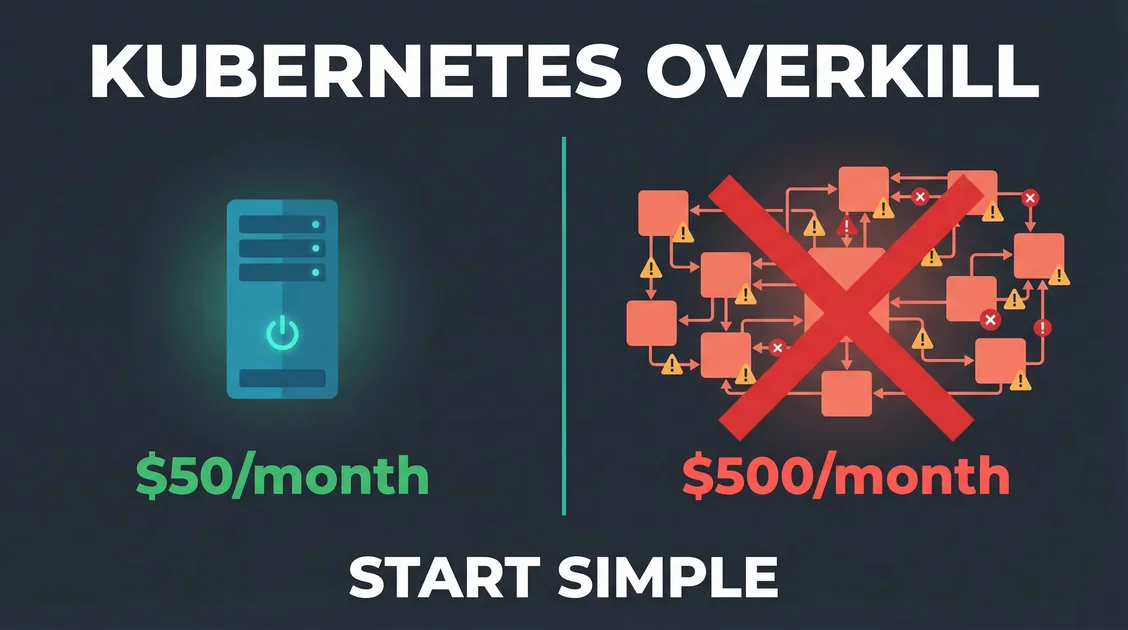
- Costs under $500/month
That’s it. Kubernetes is using a sledgehammer to hang a picture frame.
What Kubernetes Actually Costs
It’s not just the complexity. Kubernetes has real dollar costs.
Managed Kubernetes (EKS, GKE, AKS):
| Service | Monthly Cost (at MVP scale) |
|---|---|
| Control plane | ~$70/month (EKS) |
| Load balancers | $20-$50/month each |
| Node instances (minimum 2 for HA) | $100-$300/month |
| Container registry | $5-$20/month |
| Monitoring add-ons | $50-$150/month |
| Total minimum | ~$250-$600/month |
For comparison, simple alternatives:
| Service | Monthly Cost | Setup Time |
|---|---|---|
| Vercel/Netlify | $0-$20 | Minutes |
| Render/Railway | $0-$25 | Minutes |
| AWS ECS (on Fargate) | $30-$100 | Hours |
| Single EC2/DigitalOcean | $5-$40 | Hours |
The difference isn’t trivial. At MVP stage, that $250-$600/month could be hosting, customer support tools, or your entire cloud spend.
The Complexity Tax
Beyond dollars, Kubernetes costs in developer time and cognitive load.
With Kubernetes, you’re now managing:
- Pods, deployments, services, ingress
- ConfigMaps, secrets, persistent volumes
- Network policies, RBAC, service accounts
- Helm charts or Kustomize manifests
- CI/CD pipelines that build, push, deploy
- Monitoring, logging, tracing stacks
Your alternatives:
git push(Vercel, Netlify)docker-compose up(single server)- Simple dashboard click-to-deploy (Render, Railway)
Every hour your team spends debugging a Kubernetes deployment is an hour not spent building features, talking to customers, or improving your product.
The “But We’ll Scale” Fallacy
The most common justification for early K8s adoption: “We’re going to scale massively, so let’s build for it from the start.”
Here’s the uncomfortable truth: your startup probably won’t have scaling problems. 90% of startups fail. Of the 10% that succeed, most have years before Kubernetes becomes necessary.
Kubernetes becomes useful when:
- You’re running 20+ microservices
- Your infrastructure team is 2+ people full-time
- You’re spending $5K+ monthly on compute
- You have complex compliance or multi-tenant requirements
- Your team has hit the limits of simpler platforms
If you’re not there yet, you’re optimizing for a problem you don’t have.
Scale first, complicate later.
When Kubernetes Actually Makes Sense
We’re not anti-Kubernetes. We’re anti-premature-Kubernetes. Here are situations where K8s is the right call:
You’re an infrastructure startup
- If your product IS infrastructure, K8s is your product
- Example: A company building a developer platform on Kubernetes
You have an experienced infrastructure team
- Someone who has run K8s in production and knows the pitfalls
- Not someone who “watched a YouTube tutorial”
You’re migrating a legacy system
- Moving from on-premise to cloud with existing microservices
- K8s provides consistent environment for complex migrations
You have genuine scale requirements
- Millions of requests per day
- Complex multi-region deployment
- Real requirements, not hypothetical ones
You’re joining a larger organization
- Acquired by a company that standardizes on K8s
- Enterprise requirement for compliance reasons
If none of these apply, you don’t need Kubernetes yet.
What to Use Instead: A Pragmatic Stack
For most MVPs, recommend this progression:
Stage 1: Serverless/Managed Platforms (0-10K users)
| Platform | Best For | Monthly Cost |
|---|---|---|
| Vercel | Next.js, React, front-end heavy | $0-$20 |
| Netlify | JAMstack, static sites + functions | $0-$20 |
| Supabase | Backend, database, auth | Free-$25 |
| PlanetScale | MySQL database | Free-$29 |
| Railway | Full-stack apps, databases included | Free-$20 |
Deployment: git push and it’s live. No DevOps required.
Stage 2: Container Platforms (10K-100K users)
| Platform | Best For | Monthly Cost |
|---|---|---|
| Render | Dockerized apps, background jobs | $20-$100 |
| Fly.io | Global deployment, edge computing | $20-$100 |
| AWS ECS on Fargate | AWS ecosystem, simple containers | $50-$200 |
Deployment: Still simple, but more control and scaling options.
Stage 3: Consider Kubernetes (100K+ users, $5K+ monthly spend)
At this point, you have:
- Revenue to justify infrastructure investment
- Actual scaling problems simpler platforms can’t handle
- A team that can manage the complexity
The Migration Myth: “It’s Harder Later”
Common argument: “If we don’t start with K8s, migration will be painful.”
Reality check: Migrating from Vercel/Render to Kubernetes is straightforward compared to the pain of managing K8s when you don’t need it.
Containerize early: If you’re worried about migration, just use Docker from day one. Your app will run anywhere: Vercel, Render, EC2, or eventually Kubernetes.
The migration path:
- Containerized app (works everywhere)
- Deploy to simple platform (Vercel, Render)
- When scale demands it, deploy containers to K8s
The migration is redeploying containers, not rewriting architecture.
What We Recommend Instead
For 95% of MVPs we work with:
Frontend:
- Vercel or Netlify for deployment
- Automatic HTTPS, CDN, edge functions
- Zero config, git-based deployment
Backend:
- Render, Railway, or Fly.io for API servers
- Supabase or PlanetScale for database
- Simple, predictable scaling
Infrastructure as Code (eventually):
- Terraform for AWS resources (if using AWS)
- Docker Compose for local development
- Keep it simple until complexity pays for itself
Total monthly spend at launch: Typically $20-$100 Total infrastructure setup time: Hours, not weeks
The Real Conversation
When a client asks about Kubernetes, we have a real conversation:
- Do you have users yet? If no, K8s is premature.
- What’s your monthly infrastructure budget? Under $500? K8s doesn’t make sense.
- Who manages your infrastructure? A busy founder? K8s will consume them.
- What problem does K8s solve for you? If the answer is “best practices,” that’s not a real problem.
Often, the Kubernetes push comes from a technical advisor or early hire who wants to use the latest tech. But you’re building a business, not a resume.
What We’d Do Differently
We’ve seen startups waste $50K-$100K on unnecessary infrastructure before finding product-market fit. We’ve also seen startups launch on $20/month platforms and scale to millions in ARR before needing more complex infrastructure.
The difference? Ship fast, spend on product, not infrastructure.
Infrastructure is a means to an end, not the end itself.
How We Help
We advise founders on pragmatic infrastructure decisions that match their stage, scale, and budget. Our MVP Build service includes infrastructure recommendations that prioritize speed and cost-effectiveness over buzzwords.
Book a free consultation to discuss your infrastructure needs.
Need infrastructure advice for your specific situation? Let’s talk through what you actually need, not what the hype says you should want.