Development March 17, 2026
Legacy System Modernization: A Phased Approach
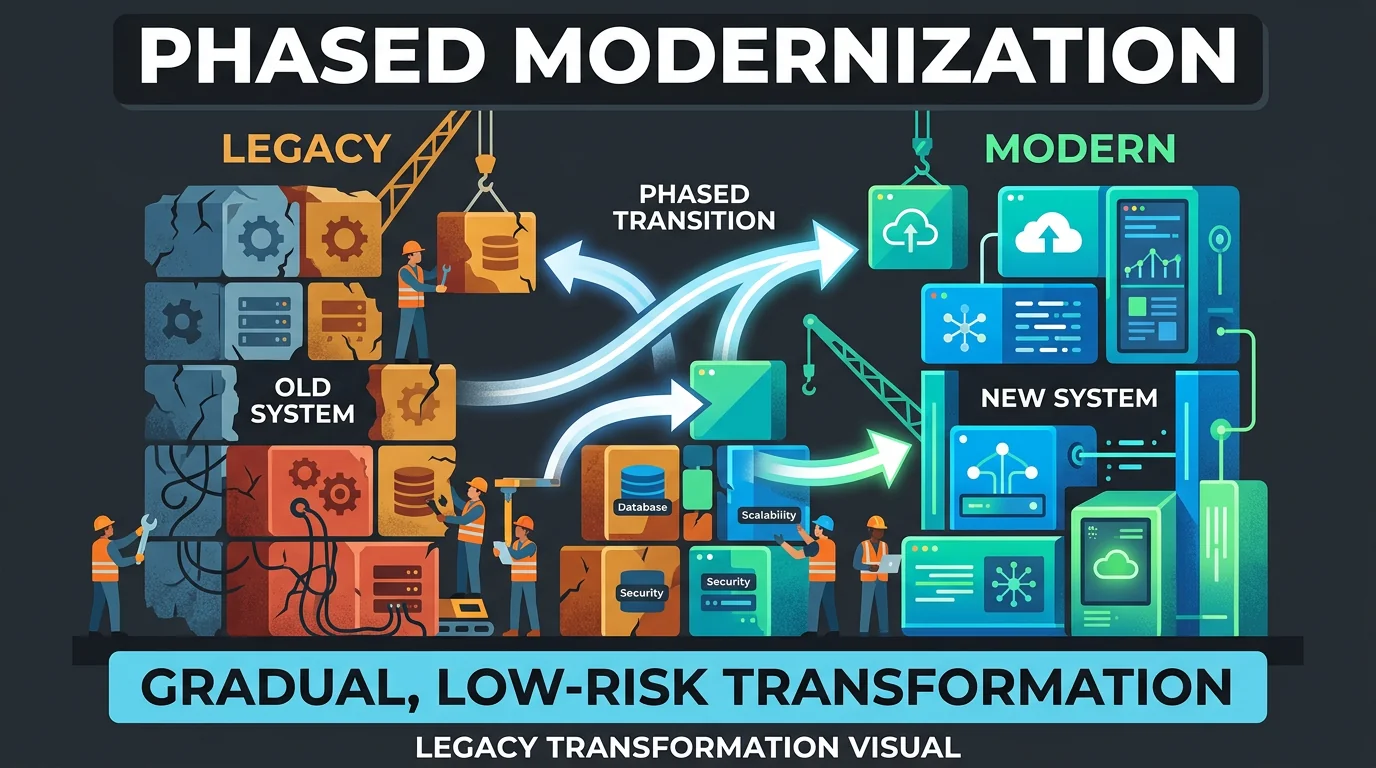
Big-bang rewrites of destroy value. A phased approach to modernization preserves business continuity while reducing risk. Here's how to modernize legacy systems systematically.
J
Jason Overmier
Innovative Prospects Team
Big-bang rewrites are high-risk and They destroy value, disrupt operations, and often fail. A phased approach to modernization transforms a legacy system gradually while preserving business continuity and reducing risk at each phase.
Phased Approach Overview
| Phase | Focus | Duration | Risk |
|---|---|---|---|
| 1. Assessment | Document current state | 2-4 weeks | Low |
| 2. Planning | Define target architecture | 2-4 weeks | Low |
| 3. Preparation | Set up parallel infrastructure | 2-6 weeks | Low |
| 4. Migration | Incrementally move users/features | 2-6 weeks | Medium |
| 5. Cleanup | Decommission old components | 2-4 weeks | Low |
Total: 10-24 weeks for a complete modernization.
Phase 1: Assessment
What to Document
| Area | Document |
|---|---|
| Architecture | Current system design, dependencies |
| Data model | Database schemas, data flows |
| Integration points | External APIs, file imports/exports |
| Business logic | Key algorithms, rules |
| Performance | Current metrics, bottlenecks |
| Technical debt | Known issues, limitations |
Assessment Questions
- What business value does this system provide?
- What are the pain points for users?
- What integrations would break if we changed this?
- What’s the the system’s hardest to change?
Phase 2: Planning
Design Target Architecture
- Modular design with clear boundaries
- Modern technology stack
- Improved developer experience
- Better scalability and maintenance
- Security by design
Migration Strategy
- Which components to modernize first?
- What can be modernized incrementally?
- What needs a complete rewrite?
- How do we handle data migration?
Phase 3: Preparation
Infrastructure Setup
- Development environment with new stack
- CI/CD pipeline for new components
- Monitoring and logging setup
- Feature flag system for gradual rollout
Team Preparation
- Training on new technologies
- Documentation of new patterns
- Code review guidelines
- Pair programming during transition
Phase 4: Migration
Strangler Fig Pattern
- Identify component to extract
- Create new service/module
- Implement feature parity
- Add dual-write path
- Migrate traffic gradually
- Monitor and validate
- Decommission old component
Dual-Write Pattern
Legacy System          New System
     ↓                    ↓
Write → Both → Read from New
     ↓
After Validation: Write to New Only
Migration Order
| Order | Component Type | Rationale |
|---|---|---|
| 1 | Infrastructure | Foundation for new components |
| 2 | Utilities | Low-risk, high reuse |
| 3 | Data access | Core functionality |
| 4 | Business logic | Domain-specific |
| 5 | API layer | External interfaces |
| 6 | UI layer | User-facing (if applicable) |
Phase 5: Cleanup
Decommissioning Checklist
- All traffic migrated to new system
- No active connections to old system
- Data migrated to new storage
- Documentation updated
- Monitoring alerts configured for new system only
- Team trained on new system
Documentation Update
- Architecture diagrams updated
- Runbooks updated or created
- API documentation current
- Incident response procedures updated
Risk Mitigation
| Risk | Mitigation |
|---|---|
| Extended timeline | Phased approach allows course correction |
| Business disruption | Dual-write pattern maintains availability |
| Data loss | Validate data migration thoroughly |
| Team resistance | Involve team in planning, provide training |
| Cost overrun | Fixed-price or capped approach |
Success Criteria
| Criterion | How to Measure |
|---|---|
| Feature parity | All features working in new system |
| Performance | Response time, throughput match or exceed legacy |
| Reliability | U99.9% uptime during migration |
| Team velocity | Feature delivery speed in new system |
| Cost efficiency | Operational costs reduced post-migration |
Legacy modernization is complex but manageable with the right approach. If you’re planning a modernization project, book a consultation. We’ll help you assess your system and plan a phased migration that minimizes risk.