Monolith vs Microservices: What's Right for Your Stage?
Microservices became the default architecture for scaling companies. But for early-stage startups, monoliths often make more sense. Here's how to choose.
Jason Overmier
Innovative Prospects Team
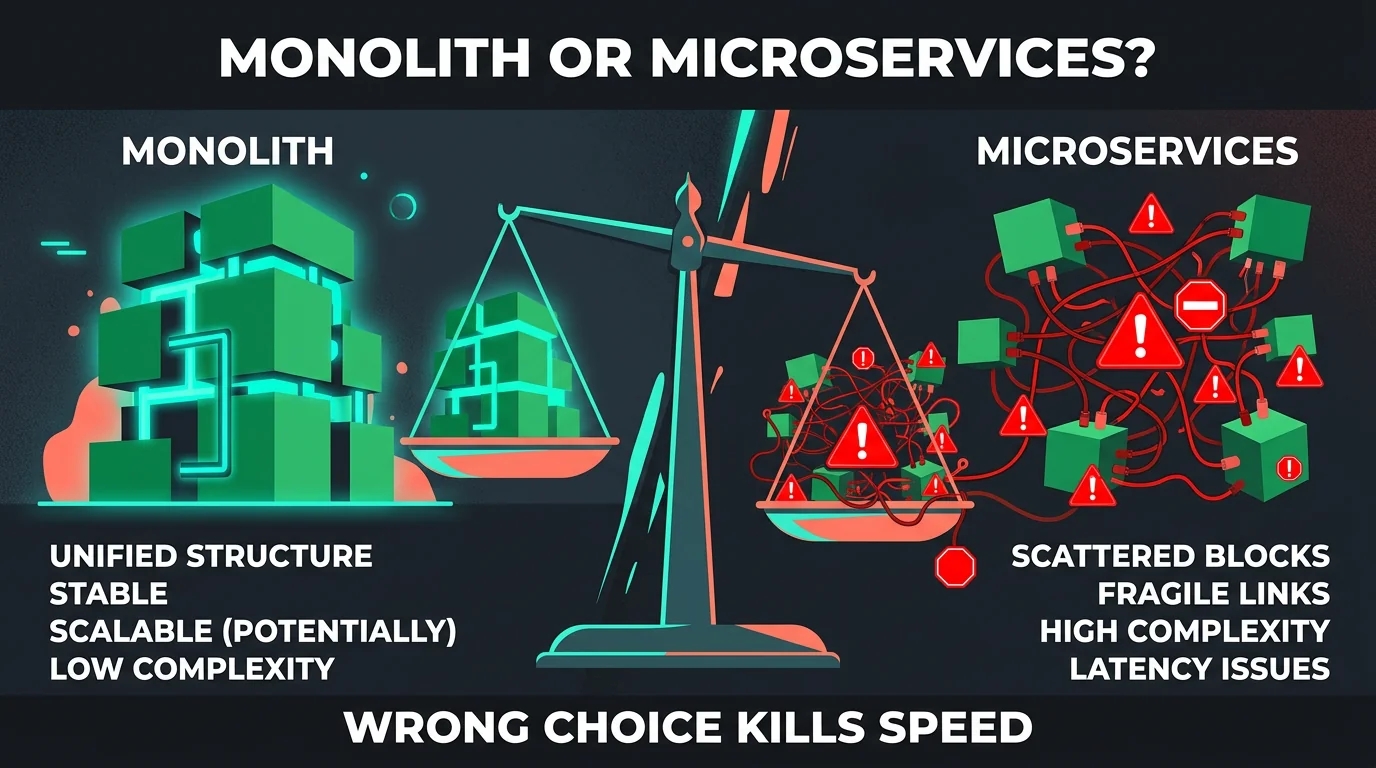
Every scaling company eventually faces the architecture question: stay with a monolith or break into microservices?
The industry default has shifted toward microservices. Tech giants use them. Conference talks celebrate them. Resume bullet points require them.
But here’s what those talks don’t mention: microservices have killed more early-stage companies than bad products have. The operational complexity, distributed system bugs, and engineering overhead can consume a small team.
The right answer depends on your stage, team size, and growth trajectory.
Quick Answer
| Your Stage | Recommendation | Why |
|---|---|---|
| Pre-product-market fit | Monolith | Speed matters more than scale |
| <10 engineers | Monolith | Microservices overhead exceeds benefits |
| 10-50 engineers | Modular monolith | Prepare for services, don’t split yet |
| 50+ engineers | Selective services | Split where team boundaries align |
| Multiple product lines | Services by product | Natural boundary, independent scaling |
If you’re reading this for an early-stage startup, the answer is almost certainly “monolith.” Read on to understand when that changes.
What’s a Monolith?
A monolithic application is a single unified codebase where all functionality runs in one process. Your authentication, business logic, database access, and API handlers all live together.
Monolith characteristics:
| Aspect | Monolith |
|---|---|
| Deployment | Single artifact, single deploy |
| Database | Shared database, transactions are easy |
| Debugging | Logs in one place, local reproduction |
| Scaling | Scale entire app, not individual components |
| Development | Simple local setup, shared code is trivial |
What Are Microservices?
Microservices break your application into small, independent services that communicate over a network. Each service owns its data, handles its business domain, and deploys independently.
Microservice characteristics:
| Aspect | Microservices |
|---|---|
| Deployment | Each service deploys independently |
| Database | Each service owns its data |
| Debugging | Distributed tracing required, harder reproduction |
| Scaling | Scale services independently based on load |
| Development | Complex local setup, network calls for shared logic |
The Hidden Costs of Microservices
Microservices solve real scaling problems. They also introduce costs that don’t appear in architecture diagrams.
Operational Complexity
| Task | Monolith | Microservices |
|---|---|---|
| Deploy | Single command | Orchestrate N services |
| Rollback | Revert and redeploy | Coordinate rollbacks across services |
| Monitor | One set of logs | Aggregate logs from N sources |
| Debug | Local reproduction | Distributed tracing, network inspection |
| Test | Integration tests run locally | Need service mocks, test environments |
For a team of 5 engineers, this overhead can consume 30-40% of engineering time.
Distributed System Problems
| Problem | Monolith | Microservices |
|---|---|---|
| Network failures | N/A (in-process calls) | Every call can fail, need retries |
| Partial failures | Process dies together | Some services up, some down |
| Data consistency | ACID transactions | Eventual consistency, saga patterns |
| Latency | Microseconds (in-process) | Milliseconds (network hop) |
These aren’t theoretical concerns. They’re production incidents waiting to happen.
The “Distributed Monolith” Anti-Pattern
Many teams end up with the worst of both worlds: services that are tightly coupled but distributed.
Signs you have a distributed monolith:
- A change to service A requires deploying service B
- Services share a database
- You can’t deploy services independently
- One service going down breaks everything
- You have services but no service boundaries
This is worse than a monolith. You’ve added network complexity without gaining independence.
When Monoliths Win
1. Early-Stage Speed
Before product-market fit, your job is learning. You need to ship, measure, and pivot quickly.
Monoliths enable this:
- Features span the full stack without coordination
- Refactoring touches everything in one PR
- Local development mirrors production
- New engineers start shipping in days, not weeks
2. Small Teams
With fewer than 10 engineers, communication overhead is low. Everyone understands the whole system. There’s no “service ownership” friction because everyone owns everything.
Microservices make sense when you have enough engineers that coordination becomes expensive. That’s usually 50+ engineers, not 5.
3. Uncertain Architecture
Early in a product’s life, you don’t know the right service boundaries. Premature splitting creates services that don’t align with domain boundaries.
A monolith lets boundaries emerge naturally. When you understand your domain, extracting services is straightforward.
When Microservices Make Sense
1. Team Scaling
When you have 50+ engineers, coordination becomes expensive. Microservices enable independent teams with clear ownership.
The rule: One team per service, one service per team. If a service requires multiple teams, it’s too big. If a team owns multiple services, they’re too small.
2. Independent Scaling
Different parts of your system have different load profiles.
Example: A notification service needs 10x the capacity of a billing service during peak hours. Running them separately saves money and ensures notifications don’t starve billing.
3. Technology Heterogeneity
Different domains benefit from different technologies.
Example: Python for ML inference, Node.js for real-time features, Go for high-throughput APIs. Microservices let you choose the right tool for each job.
4. Fault Isolation
When a non-critical service fails, the rest of the system continues.
Example: Your analytics pipeline goes down. Users can still use the product. They just won’t see reports until it recovers.
The Middle Ground: Modular Monolith
For most companies between 10 and 50 engineers, the best approach is a modular monolith.
How It Works
Your code is organized into modules with clear boundaries:
src/
├── modules/
│   ├── billing/
│   │   ├── domain/
│   │   ├── application/
│   │   ├── infrastructure/
│   │   └── interface/
│   ├── notifications/
│   ├── users/
│   └── orders/
└── shared/
Each module:
- Has a well-defined API
- Doesn’t directly access other modules’ internals
- Could become a service later (but isn’t yet)
Benefits
| Benefit | Why It Matters |
|---|---|
| Clear boundaries | When you do extract services, you know where to cut |
| Discipline | Forces thinking about service design |
| Low overhead | Still deploys as one application |
| Easy refactoring | Can still move code across modules easily |
This approach gives you 80% of microservices’ architectural benefits with 20% of the operational complexity.
Decision Framework
Answer these questions:
-
How many engineers work on this system?
- <10: Monolith
- 10-50: Modular monolith
- 50+: Consider microservices
-
Do you have clear domain boundaries?
- No: Monolith (let boundaries emerge)
- Yes: Modular monolith or microservices
-
Do you need independent scaling?
- No: Monolith is fine
- Yes: Split only the services that need it
-
Can you afford the operational overhead?
- No dedicated DevOps: Monolith
- Dedicated platform team: Microservices viable
-
Is your architecture stable?
- Still evolving: Monolith
- Well-understood: Microservices might make sense
Migration Path
If you start with a monolith (you should), how do you know when to split?
Signs You’re Ready
- You have clear service boundaries that have been stable for months
- A specific module has different scaling requirements
- A module has independent deployment needs
- Your team is large enough to own services separately
Signs You’re Not Ready
- You’re not sure what the services should be
- You want microservices because “that’s what successful companies do”
- Your team is smaller than 20 engineers
- You don’t have mature DevOps practices
How to Split
When you do extract services:
- Start with the easiest boundary - Not the most critical
- Run both in parallel - Feature flag, gradual migration
- Keep the database shared initially - Split that later
- Measure everything - Latency, error rates, operational overhead
- Reassess - If the first extraction is painful, don’t continue
Common Pitfalls
| Pitfall | Why It Happens | Fix |
|---|---|---|
| Splitting too early | Resume-driven development | Wait for clear boundaries |
| Splitting too fine | ”Micro” taken literally | Start with “macro” services |
| Sharing databases | Convenience | Each service owns its data |
| Synchronous everything | RPC feels easier | Use async where possible |
| No service contracts | ”We’ll figure it out” | Define APIs upfront |
The Pragmatic View
Successful tech companies didn’t start with microservices. They evolved toward them as scale demanded it.
| Company | Started As | Evolved To |
|---|---|---|
| Shopify | Rails monolith | Modular monolith with select services |
| Basecamp | Rails monolith | Still mostly monolithic |
| Uber | Monolithic Python | Microservices (after 1000+ engineers) |
| Netflix | Monolithic DVD rental | Microservices (after AWS migration) |
The pattern: Start simple, add complexity only when it pays for itself.
Your architecture should serve your business, not your resume. If you’re building a new product and want guidance on the right architectural approach, book a consultation. We’ll help you choose the structure that fits your stage, not the one that impressed investors.