The MVP Trap: Overbuilding Before Product-Market Fit
Startups love to build. The trap is building too much before finding product-market fit. Here's why overengineering kills startups and how to avoid the trap.
Jason Overmier
Innovative Prospects Team
Startups love to build. The engineering team has features planned. The product roadmap stretches for quarters. Everyone wants to ship something impressive.
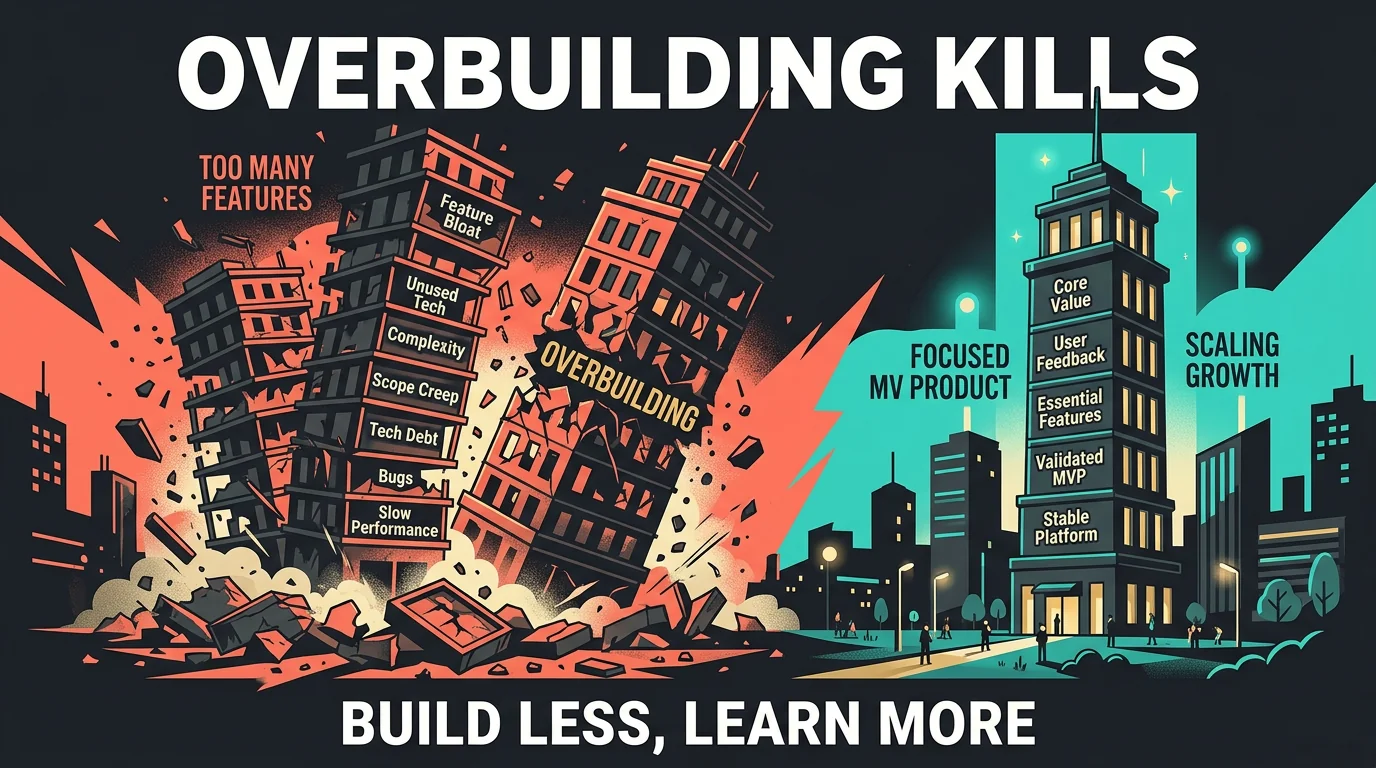
This instinct is a trap. Building too much before finding product-market fit kills more startups than execution speed, market timing, or team issues combined.
Here’s why overengineering destroys promising companies and how to resist the urge to overbuild.
The Trap
What Overbuilding Looks Like
| Signal | The Cost |
|---|---|
| Long development cycles | Competitors launch while you’s still building |
| Feature bloat | Users face complexity that prevents adoption |
| Delayed learning | You learn late that your assumptions were wrong |
| Burned runway | Money runs out before you find product-market fit |
| Team morale | Engineers want to ship, endless building demotivates |
The cycle is seductive: build more features, feel productive, run out of money before learning if anyone wants what you’s built.
Why It Happens
1. Feature FOMO
Every feature request feels essential.
| Request | Why It Seems Critical |
|---|---|
| ”Users need this” | One user requested it feature. What about the other 99? |
| ”Competitors have it” | Competitors also have 100x your users and 3 years of iteration. |
| ”It’s easy to add” | Easy features accumulate into hard complexity. |
| ”It’s just one more” | There’s always one more. |
The problem isn’t individual features. It’s the compounding effect of many features that seemed small.
2. Engineering Culture
Engineers like building. Shipping feels good.
| Behavior | The Hidden Cost |
|---|---|
| Building over shipping | Delays learning about what users actually want |
| Sophistication over simplicity | Complex systems fail in more ways |
| Features over feedback loops | You can’t iterate on what you don’t measure |
| Architecture over users | Scalability problems you don’t have yet |
3. Uncertainty Discomfort
Building feels productive. Waiting for user feedback feels uncertain.
| Feeling | What Drives It |
|---|---|
| ”We should have more to show” | Fear that MVP isn’t impressive enough |
| ”What if users don’t like it?” | Anxiety about the core value proposition |
| ”Let’s add this differentiator” | Competitive anxiety before product-market fit |
| ”We need this for enterprise” | Premature optimization for a market you haven’t validated |
The Costs
1. Runway Erosion
| Stage | Development Cost | Runway Impact |
|---|---|---|
| Core MVP | $30-50K | Standard runway usage |
| +25% features | +$20K | 40-60% more runway |
| +50% features | +$30K | 80-100% more runway |
| +100% features | +$40K | 150-200% more runway |
Each feature beyond the core MVP extends the runway required before you can start learning.
2. Opportunity Cost
Every month spent building is a month not learning.
| Activity | Learning Rate |
|---|---|
| Shipping MVP | Maximum: you’re in the market, getting feedback |
| Building features | Minimum: assumptions compound without testing |
| Talking to users | High: each conversation generates insights |
| Analyzing data | High: usage patterns reveal truth |
3. Complexity Compounds
Features don’t add linearly. They multiply.
| Features | Potential Integration Points |
|---|---|
| 5 | 10 |
| 10 | 45 |
| 20 | 190 |
| 40 | 780 |
Each feature must potentially touches every other feature. Complexity grows exponentially while features grow linearly.
How to Avoid the Trap
1. Define Your Learning Goals
Before adding any feature
| Question | If No, Don’t Build |
|---|---|
| Does this test our riskiest assumption? | It’s a nice-to-have, not a need-to-have |
| Is there a simpler way to learn this? | You’re over-investing in this learning |
| Have we talked to users about this? | You’re building based on assumptions, not evidence |
2. Implement the “One Feature” Rule
For the initial launch, commit to the principle: every feature must support the core value proposition.
| Approach | Rationale |
|---|---|
| Identify the ONE thing | What’s the single most important feature? |
| Build only that | Everything else is a distraction |
| Ship it | Get it in users’ hands |
| Iterate | Only then add the next most important thing |
3. Use the MVP Scope Framework
Categorize every potential feature:
| Category | Definition | Rule |
|---|---|---|
| Core | Product doesn’t work without it | Build now |
| Enhancement | Makes core better but not required | Build after core is validated |
| Nice-to-have | Would be nice but not critical | Don’t build until proven market |
| Distraction | Interesting but doesn’t add value | Never build |
4. Set a Feature Budget
Decide upfront how many features you MVP will have:
| Team Size | Maximum Features |
|---|---|
| Solo founder | 3-5 core features |
| Small team (2-3) | 5-10 core + enhancements |
| Medium team (4-5) | 10-15 core + enhancements |
This is your ceiling. If a feature doesn’t fit, it doesn’t get built.
5. Schedule “Kill Dates”
For each feature, set a date by which you’ll cut it if not validated:
| Feature | Kill Date | Trigger |
|---|---|---|
| Advanced search | Week 6 | If <20% of users search |
| Integrations | Week 8 | If not requested by >10% of users |
| Mobile app | Week 10 | If <15% mobile usage |
| Admin features | Week 12 | If not requested by team |
Real Examples
Example 1: The Startup That Overbuilt
Company: A B2B SaaS startup (names changed)
What they built:
- 15 core features
- 12 “essential” integrations
- 5 different user roles
- Advanced reporting
- White-label mobile app
Timeline: 14 months
Result: Ran out of money before reaching product-market fit. Post-mortem revealed that 80% of features were never used.
What they should have built:
- 3 core features
- Manual on processes for 12 “essential” integrations Estimated timeline: 4 months
Example 2: The Startup That Didn’t
Company: A developer tools startup
What they built:
- 1 core feature (the actual innovation)
- Simple CLI
- Basic documentation
Timeline: 6 weeks
Result: Shipped, got feedback, iterated. Found product-market fit at 12 months. The company is now worth 10x more after raising a $15M seed round.
Difference: They learned what to build instead of building what they thought they needed.
Signs You’re Overbuilding
Ask yourself these questions:
| Question | If Yes, Consider Cutting |
|---|---|
| Is your development timeline longer than 3 months? | You’re probably overbuilding |
| Do you have features that no user has requested yet? | You’re building ahead of demand |
| Is your product too complex for new users to understand quickly? | Complexity is killing adoption |
| Are you building features before talking to 5 users? | You’re prioritizing building over learning |
| Does your roadmap have features for “later” that you’re not focused on? | Future features are distracting from the present |
| Is anyone arguing for fewer features? | That person is probably right |
Common Pitfalls
| Pitfall | How It Happens | The Fix |
|---|---|---|
| Scope creep by committee | Each stakeholder adds “just one more” | Maintain a backlog with a formal “no” list |
| Competitor anxiety | Building features because competitors have them | Focus on differentiation, not parity |
| Perfectionism | Polishing before shipping | Ship imperfect, learn fast |
| Technical sophistication | Building cool tech instead of useful features | Prioritize boring features that work |
| Ignoring user feedback | Users aren’t using what you built | Stop building, start listening |
The overbuilding trap kills more startups than any other failure mode. Resist the temptation to build more. Ship less. Learn more. That’s how you build something people actually want.
If you’re planning an MVP and want help prioritizing features for maximum learning, book a consultation. We’ll help you define a learning-focused scope that gets you to product-market fit faster.