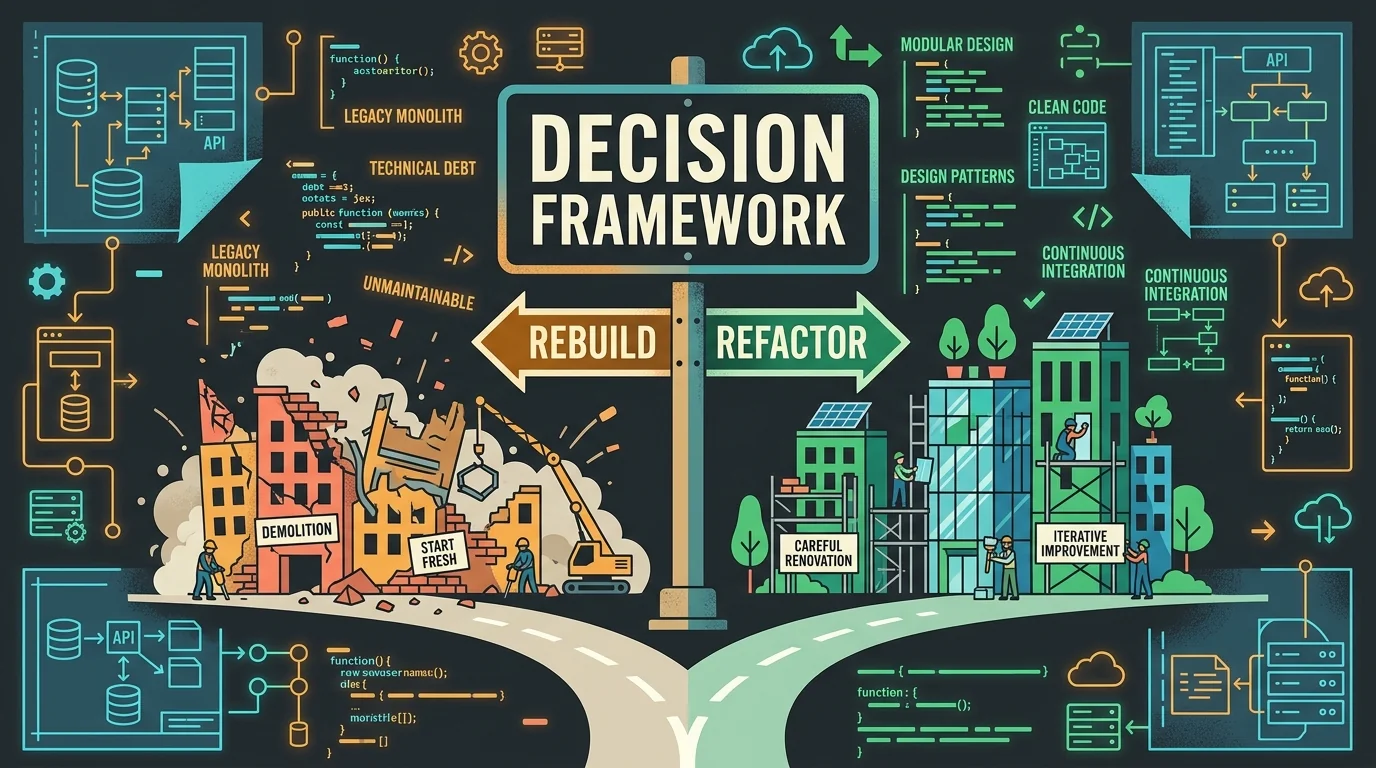
Rebuilding vs Refactoring: A Decision Framework
Teams call for a rebuild when they are tired of living with the current system. That feeling is real. It is not, by itself, a decision framework.
Jason Overmier
Innovative Prospects Team
Rebuilds are emotionally satisfying because they promise a clean slate. Refactors are frustrating because they force you to confront the system you already have.
But a clean slate is expensive, and teams often discover too late that they have thrown away working behavior, support knowledge, and hidden edge-case handling that took years to accumulate.
Decision Table
| Question | If the answer is yes | Favors |
|---|---|---|
| Is the current system still delivering business value? | The core behavior still works | Refactor |
| Are architectural boundaries recoverable? | The system can be modularized incrementally | Refactor |
| Is the stack end-of-life or impossible to hire for? | The talent or vendor risk is severe | Rebuild |
| Are compliance or security gaps fundamental? | The platform cannot be made safe enough | Rebuild |
| Do you understand the current system deeply? | Existing behavior is documented and testable | Either |
Favor Refactoring When
- The system works but is painful to change
- The main issues are coupling, test coverage, or release safety
- You cannot pause feature delivery for long
- Users depend on lots of edge-case behavior that is poorly documented
Refactoring is slower to explain and safer to execute.
Favor Rebuilding When
- The technology base is effectively dead
- Infrastructure or licensing makes the current platform economically irrational
- The product has changed so much that the original model no longer fits
- You can define a smaller, sharper target system and migrate in slices
Even then, the best rebuilds are staged. They do not start with “turn everything off and begin again.”
The Questions Leadership Should Ask
- What exactly breaks if we keep the current system for 12 more months?
- What behavior would we accidentally lose in a rebuild?
- Can we create a thin new platform while the old one keeps running?
- What is the smallest slice that proves the new direction?
Those questions usually pull teams away from ideology and toward risk management.
Common Pitfalls
| Pitfall | Why It Happens | Fix |
|---|---|---|
| Rebuild scope explodes | Teams re-imagine the whole product | Define an MVP for the new platform |
| Refactor never finishes | No explicit milestones | Tie refactors to measurable outcomes |
| Nobody budgets migration work | Feature pressure dominates | Fund modernization as first-class work |
| Teams compare ideal future to messy present | Present system flaws feel vivid | Compare real options with real costs |
Our Bias
We usually prefer refactoring first and rebuilding selectively.
That bias exists because most systems contain more reusable value than teams think, and most rewrites take longer than leadership expects. Rebuilds can absolutely be correct. They just need stronger evidence than frustration.
If you are weighing a rewrite against a phased modernization plan, contact us. We help teams model cost, migration risk, and delivery impact before they commit to either path.