Signs Your MVP Needs Technical Refactoring Before Series A
MVPs are built for speed, but some technical debt becomes toxic as you scale. Here's how to assess if your codebase needs refactoring before your next funding round.
Jason Overmier
Innovative Prospects Team
The MVP served its purpose: you validated the problem, found product-market fit, and attracted investor interest. Now you’re raising Series A, and investors are asking about your technical foundation.
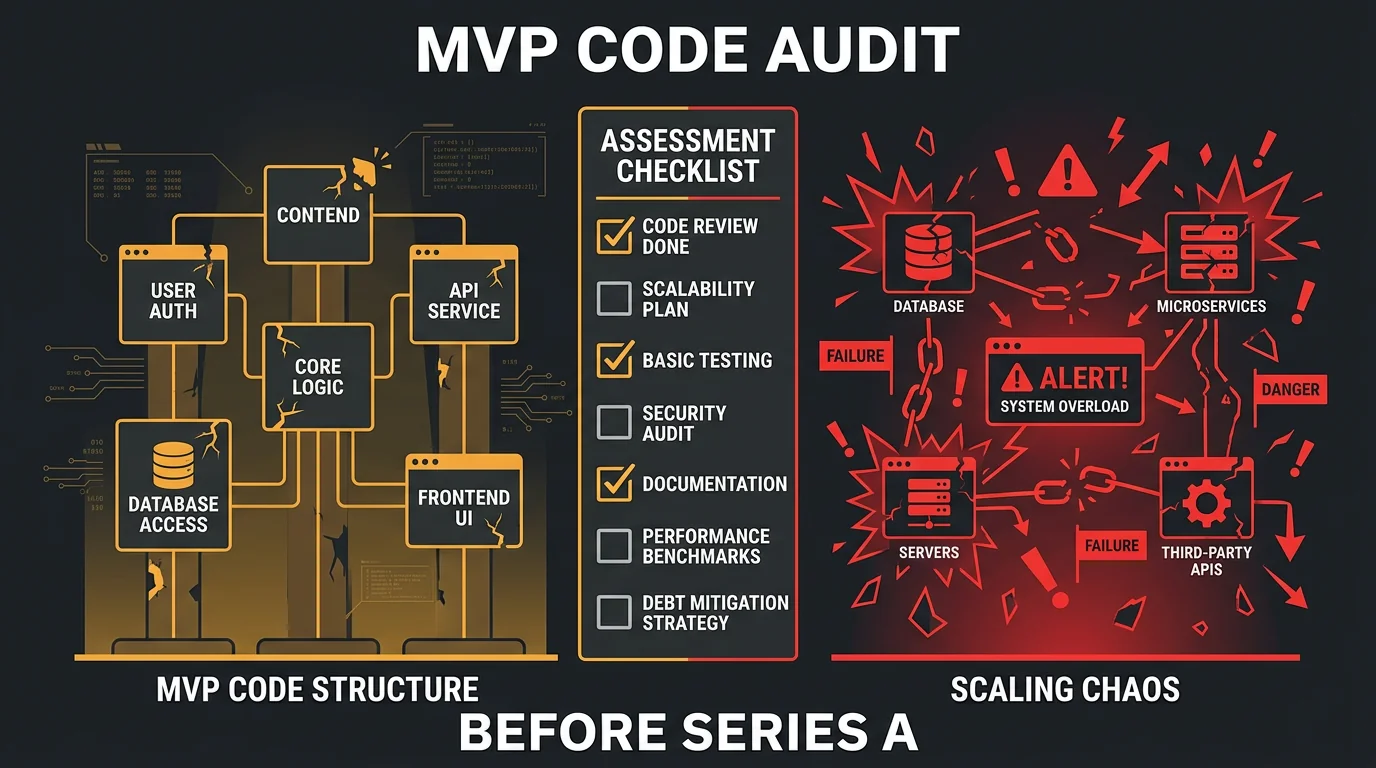
Some MVP technical debt is normal. Some is toxic. Knowing the difference determines whether you sail through technical due diligence or face awkward questions about rebuild costs.
Here’s how to assess whether your MVP needs refactoring before Series A.
Quick Assessment
| Category | Healthy Debt | Toxic Debt |
|---|---|---|
| Architecture | Simple monolith | Spaghetti dependencies |
| Code quality | Inconsistent but readable | Unreadable, no patterns |
| Testing | Core paths covered | No tests at all |
| Security | Basic measures in place | Known vulnerabilities |
| Scalability | Known limits, plan for growth | Unknown limits, scaling fails |
| Team velocity | Slightly slower than ideal | Features take weeks instead of days |
If you have toxic debt in any category, refactoring should happen before Series A.
Why This Matters for Series A
Investor Technical Due Diligence
Series A investors often bring technical advisors to evaluate your codebase. They look for:
| What They Assess | Red Flags | Green Flags |
|---|---|---|
| Scalability | System falls over at 2x load | Clear scaling path |
| Maintainability | Team can’t add features quickly | Predictable velocity |
| Security | Auth bypasses, injection risks | Proper auth, validated inputs |
| Team capability | Bus factor of 1 | Knowledge distributed |
Red flags in due diligence don’t kill deals, but they reduce valuations and create uncomfortable conversations about technical risk.
Assessment Framework
Architecture Assessment
Questions to answer:
| Question | Healthy Answer | Concerning Answer |
|---|---|---|
| Can you diagram the system? | Yes, clear boundaries | No, it’s grown organically |
| How do services communicate? | Well-defined APIs | Direct database access everywhere |
| Where does business logic live? | Clear service layer | Scattered across codebase |
| What happens if [component] fails? | Isolated failure | Cascading failure |
Signs you need refactoring:
- Circular dependencies between modules
- Database queries scattered throughout codebase
- No separation between business logic and data access
- Single points of failure without fallbacks
Code Quality Assessment
Questions to answer:
| Question | Healthy Answer | Concerning Answer |
|---|---|---|
| Can new developers understand the code? | Yes, with guidance | No, even seniors struggle |
| Are there consistent patterns? | Yes, documented conventions | No, each file is different |
| Is there documentation? | Key decisions documented | No comments or docs |
| How’s test coverage? | Core paths covered | Minimal or none |
Signs you need refactoring:
- Inconsistent naming conventions
- Deep nesting without clear purpose
- Copy-paste code throughout
- No tests for business-critical paths
Security Assessment
Questions to answer:
| Question | Healthy Answer | Concerning Answer |
|---|---|---|
| Is authentication secure? | Industry standard approach | Custom crypto, weak sessions |
| Are inputs validated? | Yes, consistently | No, SQL injection possible |
| Is sensitive data encrypted? | Yes, at rest and in transit | No, plaintext storage |
| Are dependencies current? | Yes, no known vulnerabilities | No, critical CVEs unpatched |
Signs you need refactoring:
- Passwords stored in plaintext or weak hashing
- SQL queries built with string concatenation
- API keys committed to repository
- No HTTPS or mixed content issues
- Known vulnerabilities in dependencies
Scalability Assessment
Questions to answer:
| Question | Healthy Answer | Concerning Answer |
|---|---|---|
| What’s your current capacity? | Known limit with headroom | Unknown until it breaks |
| What happens at 10x load? | Horizontal scaling plan | System crashes |
| Are there known bottlenecks? | Yes, with mitigation plan | No, haven’t tested |
| Can you handle regional expansion? | Architecture supports it | Single-region dependencies |
Signs you need refactoring:
- Single points of failure
- Database that can’t be sharded
- Synchronous operations blocking requests
- No caching strategy
- File storage without CDN
Prioritizing Refactoring
Not all debt is equal. Prioritize by impact:
Priority 1: Security and Data Integrity
| Issue | Timeline | Why It’s Priority 1 |
|---|---|---|
| Authentication vulnerabilities | Before any user growth | Breach risk is existential |
| Data encryption gaps | Before storing more data | Regulatory and trust implications |
| Input validation holes | Before marketing push | Injection risk is high |
Priority 2: Scalability Blockers
| Issue | Timeline | Why It’s Priority 2 |
|---|---|---|
| Database limitations | Before 10x user growth | Data is hardest to scale |
| Performance bottlenecks | Before marketing push | Load testing will reveal |
Priority 3: Code Quality Foundations
| Issue | Timeline | Why It’s Priority 3 |
|---|---|---|
| Test coverage | Before diligence | Shows engineering maturity |
| Code organization | Ongoing | Affects velocity |
| Documentation | Before diligence | Shows process maturity |
The Refactoring Conversation with Investors
If you need refactoring, be proactive:
What to Say
“Our MVP was built quickly to validate the market, which it did. We’ve identified areas that need technical investment before scaling, specifically [X, Y, Z]. We’ve budgeted [time/money] to address these in Q[X] and have a clear plan.”
What Not to Say
“The code is fine.” (When it’s not) “We’ll rewrite it all after funding.” (Shows poor planning) “Technical debt doesn’t matter.” (Shows immaturity)
The Plan Investors Want to See
| Element | What to Include |
|---|---|
| Assessment | What you’ve identified as needing work |
| Prioritization | Order of addressing issues |
| Timeline | When each item will be addressed |
| Budget | Resources allocated |
| Metrics | How you’ll measure improvement |
When Refactoring Can Wait
Not all debt needs to be paid before Series A:
| Debt Type | Can Wait If |
|---|---|
| Performance optimization | Current performance is acceptable for 10x scale |
| Code organization | Team can still ship features |
| Documentation gaps | Core decisions are documented |
| Test coverage | Critical paths are covered |
The question isn’t “is the code perfect?” It’s “can this foundation support growth?”
Common Mistakes
| Mistake | Why It’s Costly |
|---|---|
| Ignoring debt until diligence | Forces reactive, expensive fixes |
| Over-refactoring | Burns time that could go to features |
| Under-refactoring | Fails diligence, loses investor confidence |
| Refactoring without plan | Creates new debt while paying old |
| No technical ally in diligence | Surprised by technical concerns |
Your MVP served its purpose. Now make sure it can support your next phase of growth. If you want a technical assessment before your Series A, book a consultation. We’ve helped startups identify and address technical debt before investor scrutiny.