SQL vs NoSQL Database Selection Guide
PostgreSQL, MongoDB, Redis, and dozens of other databases all claim to be the right choice. Here's a practical framework for selecting databases based on your actual needs.
Jason Overmier
Innovative Prospects Team
Pick any database discussion and you’ll find strong opinions. SQL is “outdated” or “proven.” NoSQL is “flexible” or “messy.” Everyone has a favorite, and they’ll defend it vigorously.
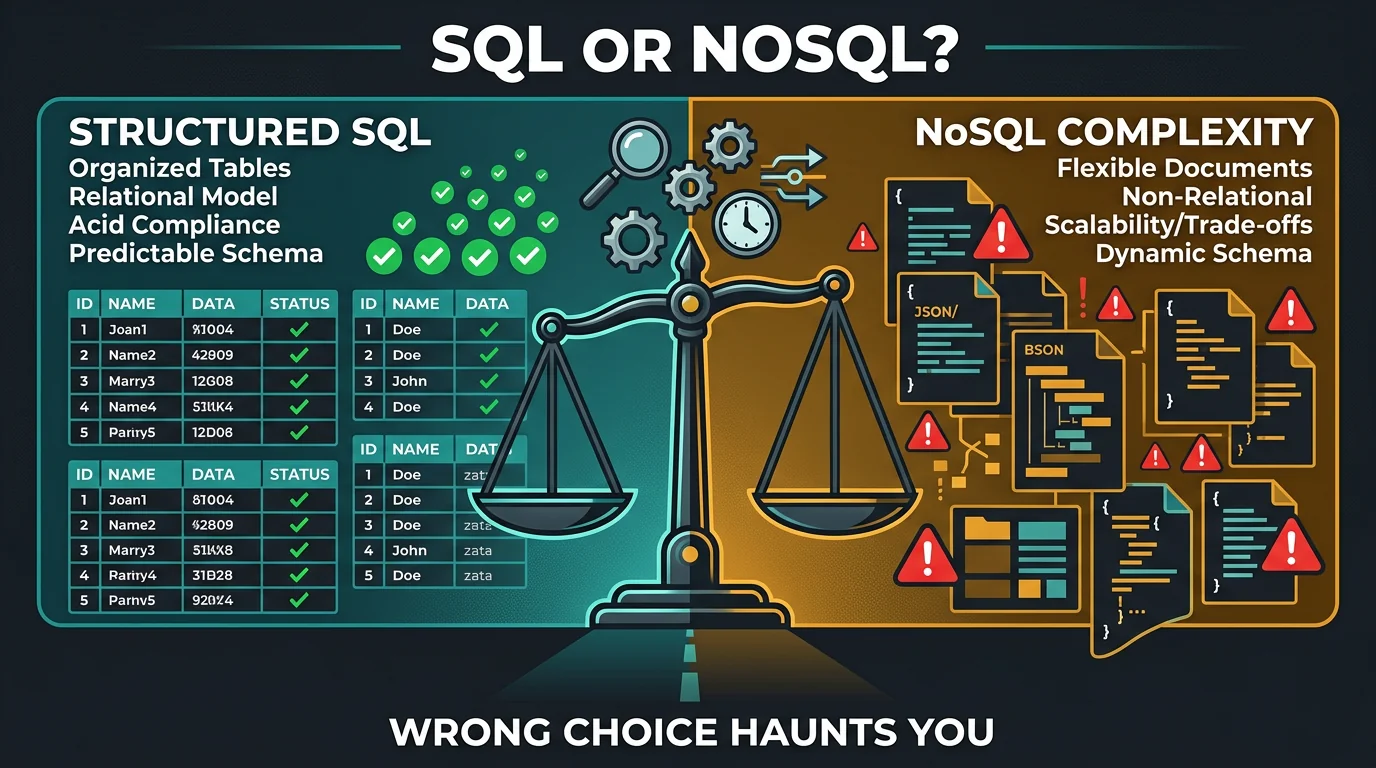
The reality is more nuanced. SQL and NoSQL databases serve different purposes. The right choice depends on your data structure, query patterns, and scaling requirements.
Here’s a framework for making the decision.
Quick Answer
| Your Data Characteristics | Recommended Approach |
|---|---|
| Structured, relational | SQL (PostgreSQL) |
| Document-based, nested | NoSQL (MongoDB, DynamoDB) |
| Key-value, caching | NoSQL (Redis) |
| Time-series, metrics | NoSQL (TimescaleDB, InfluxDB) |
| Graph relationships | Graph DB (Neo4j) or SQL with recursive CTEs |
| Mixed patterns | SQL for primary, NoSQL for specific use cases |
Most applications should start with PostgreSQL. It handles 80% of use cases well. Add specialized databases when you have specific needs.
Understanding the Categories
SQL Databases
SQL databases (relational databases) organize data into tables with predefined schemas. Relationships between tables are explicit through foreign keys.
Characteristics:
| Aspect | SQL |
|---|---|
| Schema | Fixed, defined upfront |
| Relationships | Explicit, enforced by database |
| Transactions | ACID compliance built-in |
| Queries | Powerful JOIN, aggregation |
| Scaling | Vertical (bigger server), horizontal with work |
Common choices: PostgreSQL, MySQL, SQLite
NoSQL Databases
NoSQL is a broad category covering several database types:
| Type | Description | Examples |
|---|---|---|
| Document | JSON-like documents with flexible schemas | MongoDB, DynamoDB, CouchDB |
| Key-Value | Simple storage by key, fastest access | Redis, DynamoDB |
| Column-family | Wide columns, sparse data | Cassandra, HBase |
| Graph | Nodes and edges for relationships | Neo4j, Neptune |
| Time-series | Optimized for time-ordered data | TimescaleDB, InfluxDB |
When SQL Wins
1. Relational Data
Your data has clear relationships that matter.
Example: E-commerce with customers, orders, products, and inventory. Orders belong to customers, contain products, affect inventory. SQL makes these relationships explicit and enforces them.
-- Clear relationships, enforced by database
SELECT o.id, c.name, p.title, oi.quantity
FROM orders o
JOIN customers c ON o.customer_id = c.id
JOIN order_items oi ON o.id = oi.order_id
JOIN products p ON oi.product_id = p.id;
2. Complex Queries
You need JOINs, aggregations, and ad-hoc analysis.
Example: Analytics dashboards that slice data by multiple dimensions. SQL excels at “show me revenue by region, product category, and customer segment for Q4.”
3. Transaction Integrity
You need ACID guarantees: Atomicity, Consistency, Isolation, Durability.
Example: Financial transactions where partial failures would cause real harm. SQL databases have solved this problem for decades.
4. Evolving Schema with Migrations
Your schema changes but in controlled ways.
Example: Adding columns, creating indexes, adjusting constraints. SQL migrations give you version control over schema evolution.
When NoSQL Wins
1. Document-Based Data
Your data is naturally hierarchical and doesn’t fit tables cleanly.
Example: Product catalogs where each product has different attributes. A shirt has size and color; a laptop has CPU, RAM, and storage. Documents handle this naturally:
{
  "type": "laptop",
  "specs": { "cpu": "M3", "ram": "16GB", "storage": "512GB" },
  "price": 1299
}
2. High-Volume, Simple Access Patterns
You’re writing massive amounts of data and accessing by key.
Example: Session storage, user preferences, or event logging. You write millions of records and retrieve by ID. NoSQL key-value stores excel here.
3. Flexible Schema Requirements
Different records have different structures, and that’s expected.
Example: User profiles where different users store different information. Some have social media links; others have professional credentials. Forcing this into a fixed schema creates sparse tables or complex joins.
4. Horizontal Scaling Needs
You need to distribute data across many servers, and your access patterns support it.
Example: Global application with users in multiple regions. Some NoSQL databases make geographic distribution easier than traditional SQL.
The PostgreSQL Default
For most new projects, PostgreSQL is the right starting point.
Why PostgreSQL Wins By Default
| Capability | PostgreSQL |
|---|---|
| JSON support | Store and query JSON when needed |
| Full-text search | Built-in, no Elasticsearch required |
| Time-series | TimescaleDB extension |
| Geographic data | PostGIS extension |
| Analytics | Window functions, CTEs, materialized views |
| Reliability | 35+ years of development |
PostgreSQL lets you start relational and add NoSQL patterns when needed. It’s not always the best at any single thing, but it’s good enough at almost everything.
When to Add Specialized Databases
| Need | Add This |
|---|---|
| Caching | Redis (in-memory speed) |
| Search | Elasticsearch (if PostgreSQL full-text isn’t enough) |
| Time-series at scale | TimescaleDB or InfluxDB |
| Queue/worker coordination | Redis |
| Global distribution | DynamoDB or CockroachDB |
Decision Framework
Evaluate your application against these criteria:
1. Data Structure
| Data Type | Lean Toward |
|---|---|
| Clear entities with relationships | SQL |
| Nested, hierarchical documents | Document store |
| Simple key-value pairs | Key-value store |
| Time-stamped events/metrics | Time-series |
2. Query Patterns
| Query Type | Lean Toward |
|---|---|
| Complex JOINs, aggregations | SQL |
| Simple lookups by ID | Key-value |
| Document queries by attributes | Document store |
| Time-range queries | Time-series |
3. Scale Requirements
| Scale | Consider |
|---|---|
| <1M records | Anything works |
| 1M-100M records | SQL handles this fine |
| 100M-1B records | SQL with good indexing, or NoSQL |
| 1B+ records | Specialized solution based on access patterns |
4. Consistency Requirements
| Need | Choose |
|---|---|
| Strong consistency (always correct) | SQL with ACID |
| Eventual consistency OK (available first) | Some NoSQL options |
Common Combinations
Most production systems use multiple databases for different purposes:
Typical Stack
| Database | Purpose |
|---|---|
| PostgreSQL | Primary data, transactions |
| Redis | Caching, sessions, queues |
| Elasticsearch | Full-text search (optional) |
E-commerce Example
| Data | Database | Why |
|---|---|---|
| Customers, orders, inventory | PostgreSQL | Relational, transactional |
| Product catalog | PostgreSQL JSONB or MongoDB | Flexible attributes |
| Session data | Redis | Fast, temporary |
| Search | Elasticsearch | Complex search queries |
Analytics Platform Example
| Data | Database | Why |
|---|---|---|
| Users, accounts | PostgreSQL | Relational |
| Events | TimescaleDB | Time-series optimized |
| Real-time dashboards | Redis | Caching aggregated data |
| Log data | Elasticsearch | Searchable logs |
Common Pitfalls
| Pitfall | Why It Happens | The Cost |
|---|---|---|
| Choosing NoSQL for “scalability” before you need it | Premature optimization | Lost relational benefits, added complexity |
| Using MongoDB for everything | JSON feels easy | Missing relationships, poor query capability |
| Ignoring SQL because “it’s old” | Chasing trends | Rejected decades of proven solutions |
| No caching layer | Database can handle it | Expensive queries repeated unnecessarily |
| Multiple databases too early | ”Best tool for each job” | Operational complexity explodes |
Migration Considerations
If you choose wrong, how painful is migration?
| From | To | Difficulty |
|---|---|---|
| SQL to SQL | Schema migration | Easy |
| NoSQL to SQL | ETL, schema design | Medium |
| SQL to Document | Denormalization | Medium |
| Document to SQL | Normalization, schema design | Hard |
| Key-value to anything | Depends on data structure | Varies |
The lesson: Start with the more structured option (SQL) when uncertain. Migrating from SQL to NoSQL is easier than the reverse.
Practical Recommendations
For a New Startup
- Start with PostgreSQL
- Add Redis for caching when you need it
- Consider specialized databases only when you have a specific problem
For Specific Domains
| Domain | Recommendation |
|---|---|
| SaaS applications | PostgreSQL + Redis |
| E-commerce | PostgreSQL + Redis + optional Elasticsearch |
| Social media | PostgreSQL for relationships, Redis for feeds |
| IoT/telemetry | PostgreSQL + TimescaleDB |
| Content management | PostgreSQL or MongoDB for documents |
| Real-time analytics | PostgreSQL + Redis + time-series DB |
Database selection is one of the earliest and most impactful architecture decisions. If you’re building a new application and want guidance on the right data layer, book a consultation. We’ll help you choose based on your actual needs, not trends.