System Architecture in the AI Age: What AI Cannot Do
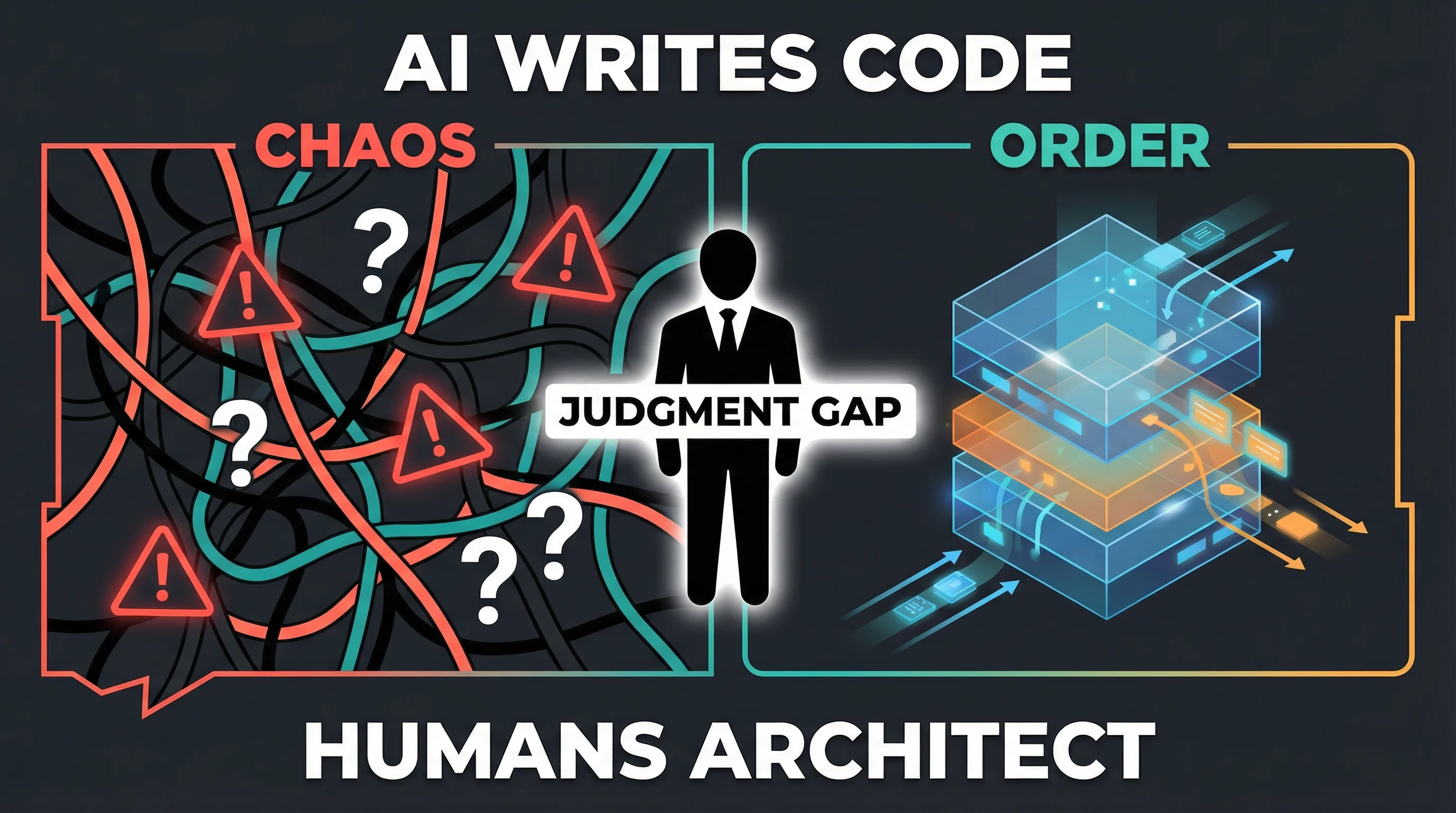
AI writes code faster than any human, but it cannot architect systems. The human judgment gap is widening, and that's your competitive advantage.
Jason Overfier
Innovative Prospects Team
The Architecture Gap
AI can write a REST endpoint in seconds. It can generate database schemas, implement caching layers, and even suggest scalability patterns. But it cannot tell you which of those choices you should actually make.
This is the architecture gap, and it’s widening every day.
Senior engineers have watched their role shift from writing code to making decisions. AI has commoditized implementation, but it cannot commoditize judgment. The ability to make trade-offs, understand long-term consequences, and architect systems that survive contact with reality remains exclusively human.
This article explores why architecture matters more than ever, and how to position your expertise where AI cannot follow.
What AI Actually Does Well
Before discussing the gap, let’s acknowledge what AI tools excel at:
| Capability | Why AI Excels | Where It Fails |
|---|---|---|
| Code generation | Trained on billions of patterns | Cannot assess appropriateness for your context |
| Pattern matching | Identifies common architectures | Cannot invent novel solutions for novel problems |
| Documentation | Explains what code does | Cannot explain why you chose this approach |
| Debugging | Finds obvious errors | Cannot spot subtle architectural flaws |
| Refactoring | Applies local improvements | Cannot see system-wide consequences |
AI is a force multiplier for implementation. It accelerates the work you already know how to do. But it cannot make decisions that require understanding your business context, team capabilities, risk tolerance, and constraints that have never been written down.
The Three Dimensions of Architectural Judgment
Architecture judgment operates in three dimensions where AI has no data.
1. Contextual Awareness
AI sees your code, but it cannot see:
- Your team’s experience level and velocity patterns
- The political landscape of your organization
- Which systems are owned by teams you can and cannot trust
- The real deadlines vs. the stated deadlines
- Which technical debt is acceptable and which is fatal
Example: An AI might suggest implementing an event-driven architecture for a new feature. A human architect knows that the data science team doesn’t understand events, the operations team refuses to run message brokers, and you have three weeks to launch. The judgment call: build a simpler synchronous system first, evolve toward events later.
2. Temporal Reasoning
AI operates in the present. Architecture operates across time:
| Time Horizon | Architectural Concern | AI Capability |
|---|---|---|
| Now | Ship the feature | Excellent |
| 6 months | Manageable complexity | Limited |
| 2 years | Evolution path | Blind |
| 5+ years | Platform durability | Irrelevant |
Every architectural decision is a bet on the future. AI cannot help you weigh the probability that a third-party service will exist in two years, whether your team will grow or shrink, or which requirements will change.
Example: Choosing between PostgreSQL and MongoDB for a new project. AI can list feature differences. Only human judgment can assess that your hiring pipeline produces mostly Postgres developers, your compliance requirements mandate transactional consistency, and your CEO has expressed skepticism about “trendy databases.”
3. Risk Assessment
AI optimizes for functional requirements. Architecture requires optimizing for non-functional requirements that often conflict:
- Performance vs. maintainability
- Security vs. developer experience
- Cost vs. reliability
- Speed to market vs. flexibility
Every “yes” to one dimension is a “no” to another. AI cannot tell you which trade-offs align with your risk tolerance.
The AI-Resistant Architect: Core Competencies
If implementation is commoditized, where should senior engineers focus? The answer is in AI-resistant skills.
System Boundaries
The most important architectural decisions are about what not to build.
- Service boundaries: What belongs in one system vs. another?
- Team boundaries: What can one team own end-to-end?
- Buy vs. build: What should you use a vendor for?
- Scope: What problem are you actually solving?
AI generates code. Architects define boundaries. The person who draws the box around the problem creates more value than the person filling it in.
Data Architecture
Data flow determines system behavior. AI can write queries, but it cannot:
- Design data models that survive requirement changes
- Identify where eventual consistency is acceptable
- Spot the migration that becomes impossible six months from now
- Recognize when a “simple” change requires a re-architecture
The most expensive architectural failures are almost always data architecture failures.
Technology Selection
AI can compare frameworks on features. It cannot tell you:
- Which framework has a hiring pool in your city
- Which open-source projects are actually maintained
- Which vendors will survive acquisition
- Which technologies your team will resent using
Technology selection is a bet on people, not code. AI has no people data.
Integration Patterns
Most systems fail at the edges, not the core. AI can implement individual services. It cannot:
- Design APIs that evolve without breaking consumers
- Spot the integration pattern that becomes a performance bottleneck
- Identify where circuit breakers and retries are needed
- Recognize when synchronous calls become distributed systems traps
Integration is where architectural theory meets operational reality.
The Architecture Audit: A Diagnostic Framework
If you’re wondering whether your team is leaning too heavily on AI for architectural decisions, run this diagnostic:
| Signal | AI-Reliant | Architecture-Led |
|---|---|---|
| Decision making | ”Claude suggested it” | Documented trade-off analysis |
| Review focus | Code style | System boundaries and data flow |
| Meetings | Implementation details | Requirements and constraints |
| Documentation | Code comments | Architecture decision records (ADRs) |
| Failure response | ”Fix the bug" | "What systemic issue allowed this?” |
| Tech choices | ”Best practice” | Context-specific justification |
Common Pitfalls
| Pitfall | Why It Happens | Fix |
|---|---|---|
| Treating AI as architect | Easy answers, fast implementation | Require ADRs for significant decisions |
| Optimizing for implementation speed | AI accelerates coding | Measure velocity, but track technical debt |
| Ignoring team context | AI doesn’t know your team | Document constraints and capabilities |
| Over-engineering for flexibility | AI suggests every pattern | YAGNI: build for now, design for evolution |
| Deferring decisions | ”AI will handle it later” | Architectural decisions must be explicit |
The New Engineering Value Chain
The value chain for engineers has shifted:
| Activity | Value | AI Leverage |
|---|---|---|
| Requirements discovery | High | Low |
| Architectural design | Critical | Low |
| Implementation | Medium | High |
| Testing | Medium | Medium |
| Operations | High | Medium |
Senior engineers who remain in the “implementation” row will see their value decline. Those who move up the chain—into requirements, architecture, and operational excellence—will see their value increase.
Making Architecture Visible
Architecture work is often invisible. If you want your AI-resistant expertise to be recognized, make it visible:
Architecture Decision Records (ADRs): Document significant decisions with context, options considered, and trade-offs. The format is less important than the discipline of explicit reasoning.
Architecture Diagrams: Keep C4 models or similar documentation current. Diagrams that don’t reflect reality are worse than no diagrams at all.
Review Process: Require architectural review for non-trivial changes. Code reviews catch implementation bugs. Architecture reviews catch design bugs.
Post-Mortems: When systems fail, analyze the architectural decisions that led to failure. Was the trade-off analysis sound? What was missed?
The Competitive Advantage
Here’s the strategic reality: your competitors can use the same AI tools you can. They can generate similar code at similar speeds. What they cannot copy is your architectural judgment.
- Your understanding of your business context
- Your ability to make good trade-offs
- Your experience with what actually works in production
- your network of human experts to call on
These are AI-resistant differentiators. The companies that win in the AI age will be the ones that use AI to accelerate implementation while doubling down on human architecture.
Need help strengthening your architectural foundation? Our senior architects have designed systems serving millions of users across healthcare, fintech, and logistics. Book a free consultation to discuss your system architecture challenges.