Technical Debt Audit: What to Look For
Technical debt is not just ugly code. It shows up in release risk, weak ownership, fragile integrations, and the kinds of defects teams stop noticing because they see them every week.
Jason Overmier
Innovative Prospects Team
Most technical debt audits fail because they focus on style problems and miss operational debt.
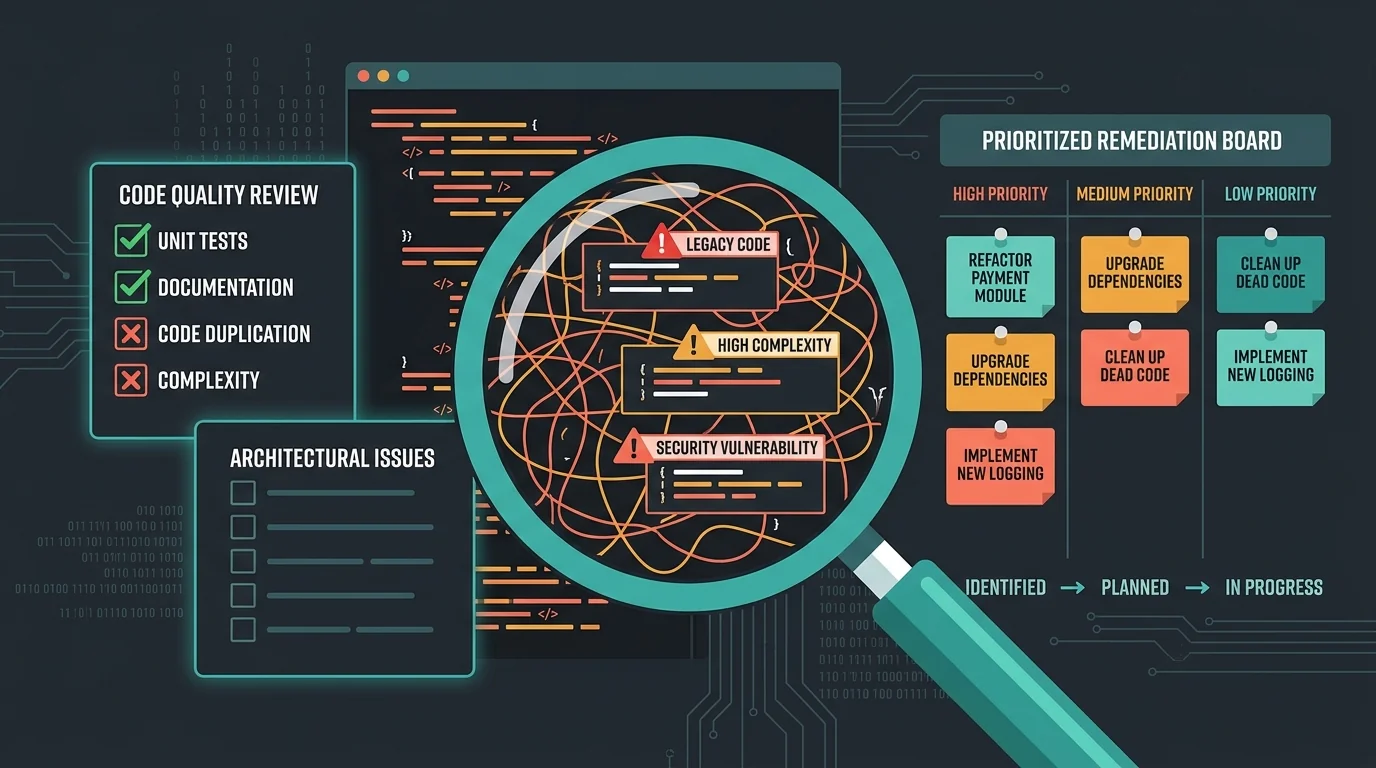
A real audit should tell you where delivery is slowing down, where reliability is being traded away, and which parts of the system are expensive to change. It should give leadership a prioritized remediation list, not a vague statement that the codebase needs cleanup.
Audit Scorecard
| Area | What to Check |
|---|---|
| Architecture | Coupling, boundary clarity, circular dependencies |
| Code health | Duplication, complexity, dead code, weak testability |
| Delivery | Release friction, rollback ability, CI reliability |
| Operations | Monitoring gaps, alert quality, incident history |
| Security | Secrets handling, dependency hygiene, auth weaknesses |
| Ownership | Docs, maintainers, escalation paths, support burden |
Code Signals That Matter
These are the code-level signs worth tracking:
- Large files nobody wants to edit
- Repeated conditionals encoding business rules in multiple places
- Feature work that requires touching unrelated modules
- Test suites that pass slowly or fail unpredictably
- Framework or dependency upgrades that have been deferred for months
None of those are fatal alone. Together they are a debt map.
Operational Signals Matter More
Technical debt usually hurts the business through operations first.
| Signal | What It Usually Means |
|---|---|
| Frequent hotfixes | Change safety is weak |
| Long incident resolution time | Observability or ownership is poor |
| One engineer knows the critical path | Institutional knowledge debt |
| Releases happen infrequently | Deployment process is too risky |
| Bugs reappear after fixes | Root causes are not being removed |
If you only audit code and ignore those signals, you miss the expensive part.
Prioritize by Cost of Delay
Not all debt deserves the same urgency.
Use three buckets:
| Priority | Description |
|---|---|
| P1 | Blocks delivery, creates security or reliability risk |
| P2 | Slows development materially but has workarounds |
| P3 | Worth addressing during nearby feature work |
This framing helps teams stop treating every cleanup task like an equal emergency.
Common Pitfalls
| Pitfall | Why It Happens | Fix |
|---|---|---|
| Audit becomes opinion-based | No shared rubric | Use a repeatable scorecard |
| Team hides the worst areas | Fear of blame | Audit systems, not people |
| Everything gets labeled urgent | Debt is frustrating | Rank by business impact |
| Report dies in a slide deck | No owner or timeline | Turn findings into a remediation backlog |
What a Good Output Looks Like
A useful debt audit ends with:
- Top risks by business impact
- Systems or modules ranked by change difficulty
- Quick wins that reduce support burden
- A 30/60/90-day remediation plan
- Clear ownership for each follow-up action
That gives leaders a way to fund the work and engineers a way to execute it.
If your team is moving slower every quarter and nobody can agree why, let’s talk. We run technical debt audits that turn vague frustration into a concrete modernization plan.